|
One might divide amateur radio public service activities into two categories, one of which is essential services, and the other of which might be called value-added services. Understanding the nature of these two categories has become increasingly important as commercial and government telecommunications environments become more diverse and robust.
Essential Services:
While few would argue with the assertion that emergency service communications networks are far more reliable today, the fact remains that these systems do have vulnerabilities and limitations.
Yet, fewer disaster situations require amateur radio support to fill in gaps or overcome inherent limitations in these systems.
Therefore, some radio amateurs use this reality to assume that we are no longer needed.
So, let’s examine that assumption.
It is the job of emergency management and relief organizations to conduct a thorough hazard and vulnerability analysis for their community or state.
In doing so, consideration must be given to potential disasters that, although rare, can overwhelm or damage public safety communications systems.
Like their professional counterparts, radio amateurs should also prepare for those rare situations in which “all else fails.”
The emergency management process, if properly conducted, requires coordination between numerous agencies and organizations, many of which do not normally utilize public safety communications networks.
Even in the case of emergency situations that are less than catastrophic, organizations like ARES® and NTS can play an important role by providing the flexible and scalable communications resources needed to enhance coordination and information flow within the broader emergency management environment, thereby ensuring a cohesive response phase operation.
This brings us to an essential point: The bar for providing these essential services is rather high.
Amateur radio volunteers must be able to do more than establish connectivity.
They must be able to communicate efficiently and accurately.
Senior volunteers need to understand how to function both within the emergency services environment and within the context of an operational EOC or message center.
This means real training and experience conveying message traffic and managing important administrative tasks involving radio logs, records, and accountability.
Value-Added Services:
There are many opportunities for radio amateurs to assist with, other than significant disasters.
A two-way radio network remains an excellent tool for coordinating a distributed event such as a parade, a marathon, severe weather events, or smaller emergency operation that falls outside the scope of normal emergency services operations.
There remains great value in cohesive volunteer organizations that can provide not just real-time information, but also a level of quality control that renders the information of greater value than random inputs from public sources.
While it is important for Section leadership to not fall into the trap of simply becoming “emergency management volunteers who bring their own radios,” there are many events and situations in which Amateur Radio Service resources can greatly enhance safety and efficiency.
These activities of lesser scale also provide a perfect opportunity to practice the essential skills needed to respond to those less common situations in which essential services are required. Best of all, they can provide a sense of purpose for ARES® and NTS volunteers.
Diminishing Relevance?
Fifty years ago, the ability to establish connectivity alone was valuable simply because mobile or portable two-way radio capability was a rarity.
It so happens that many radio amateurs at that time also had experience with traffic handling, commercial and maritime communications, or military experience.
When called upon to fill gaps in communications infrastructure, radio amateurs often rose to the occasion with efficient and accurate communications.
Today, the ability to establish connectivity is no longer a rare asset.
However, the ability to support a disaster operation with excellent administrative skills, solid operating procedures, and efficient, accurate, traffic handling remains a high-value element in either a disaster operation or a community service event.
However, one can’t learn the needed skills “on the job.” Effective, peer-reviewed training and effective drills and practice are needed to ensure that radio amateurs can do more than establish connectivity; rather, it ensures they can communicate.
Quo Vadis?
Perhaps amateur radio finds itself on a modern Appian Way, confronting a rapidly evolving telecommunications environment in which its destiny will be determined.
One choice leads to diminished relevance whereas the other leads to a future in which amateur radio remains a valued community asset.
If we want to choose the latter path, our volunteers must develop the solid communications, technical, and administrative skills needed to do so.
This means prioritizing real training and experience in the core competencies of effective communications.
Examples include:
-
Ensuring your ARES® organization has regular connectivity to NTS traffic nets and other infrastructure-level systems.
-
Conducting training drills in message handling (radiogram and radiogram-ICS213) during weekly two-meter nets (see an example at: radiorelay.org/files/training/RRI-TR-005-Phonetic-Alphabet-Training-Rev-A.pdf)
-
Using community service events to set up a simulated message center which incorporates the administrative tasks that might be needed in a major disaster.
-
Prioritizing training that emphasizes the core skills of communications methods and technical tasks.
-
Using our amateur radio networks for routine reports and basic administrative functions within your section, rather than relying upon commercial common carrier methods.
Lastly, don’t forget that volunteers need a sense of purpose.
Get involved in an NTS traffic net, if only one or two days a week.
Use NTS and ARES nets to report routine weather data to the National Weather Service.
During the warmer weather months, host events in which volunteers set up in the field and originate one or two pieces of message traffic.
Exercise your creativity.
Use your volunteer resources wisely.
Find that balance where they have a sense of belonging and purpose while gaining the skills needed to remain a valuable community asset.
Our future depends on it.
– James Wades, WB8SIW
|
|
Alerting and Mobilizing Amateur Radio Operators in Times of an Emergency |
|
Many major incidents (hurricanes and snowstorms, for example) are proceeded by warnings before they impact an area. Others (perhaps earthquakes) can hit without warning. Incidents can affect areas varying from very localized to large-scale regional and potentially country-wide impact.
A challenge for mobilizing amateur radio operators is how to alert them that there is a communications support need when a major incident occurs, often in the absence of traditional communications. To explore these issues, a team drawn from the transcontinental NBEMS net held an alerting exercise on Jan 17, 2026.
The exercise consisted of two parts:
- Alerting via text over cell phone to obtain a baseline for fastest reasonable time for alerting a team of amateur radio operators
- An exercise using alerting via HF radio, only to understand the additional latency which is introduced when relaying a radio-only alert across the country
-
The radio-only alerting used a modified version of the FSQ mode in FLDIGI. This alerting approach developed by Jon Chappell, W1UVX
-
This is similar conceptually to the SHARES alerting system as described by Stephen Hansen, KB1TCE
Twelve individuals participated in the cell phone alerting exercise and 14 operators from across the continental US participated in the radio alerting exercise.
The findings from this exercise were:
1. Text-based alerting had about a 60% alerting rate in 15 minutes, 91% alerting in 30 minutes and 100% in one and one half hours
2. Radio-only alerting is possible and can, in principle, span the country in five minutes or less
In addition, during the testing
3. several stations tested SDR systems using compact antennas, demonstrating the ability to configure low-cost radio-only alerting systems (similar to weather alerting systems but operating on HF) which functioned successfully during the radio-only exercise.
These tested the minimum expected time one can achieve with alerting and demonstrated that a radio-only alerting approach would introduce perhaps an additional five minutes of latency. Further, in principle, radio-only alerting can be implemented using relatively inexpensive hardware and without requiring the dedication of a full HF amateur radio installation to support the alerting process. – Don Rolph, AB1PH
|

|
|
|
NTS 2.0 Traffic Performance Testing |
|
On January 23, the NTS 2.0 Performance and Standards Team initiated its first round of NTS traffic performance testing using the new HXT handling instruction with a set of radiograms sent between Ohio, Michigan, and New York.
If you were to look up the description for this handling instruction, you would see that it means “Special traffic test message, ID_______”. So, what is this all about? What are we hoping to achieve? And what should you do if you end up with a radiogram that has this handling instruction?
The overall goal is to improve the performance of the National Traffic System.
The desire is to quantify system coverage and identify gaps, and to understand the system's performance in terms of delivery time, reliability, and errors.
The results will be analyzed and used to make improvements, and to address issues which were identified.
How will this be accomplished?
Enter the NTS 2.0 Test Traffic Reporting Application, developed by Jonathan Taylor, K1RFD, creator of the NTS 2.0 Radiogram Portal. This tool contains a user-friendly website into which traffic handlers can enter information about any radiogram containing the HXT handling instruction that they happen to handle (originate, relay, receive as addressee, or deliver). The information is collected into a database which can then be used for reporting and analysis.
So, let’s say you receive a radiogram, and the handling instruction says “HXT 10.” Apart from the usual routine of delivering the message to the addressee (if not yourself) or moving it along to the next leg of its journey through the National Traffic System, what additional action does this radiogram require? Well, you will note that the text of the radiogram will direct everyone handling it to a website, nts2.arrl.org/test. From there you will be prompted to enter your call sign and the Test Set ID.
Use the numbers after the “HXT” in the handling instruction as the Test Set ID.
So, in our example, you would enter “10.” Note that this is not the message number.
A test set consists of multiple individual radiograms.
You will next encounter a drop-down list of message numbers (here’s where that comes into play) along with the call sign of the originating operator.
If there have been no errors in transmission, you should see your radiogram show up in this list.
Select the appropriate radiogram and enter the requested information.
It only takes a couple of minutes, and you will then become a much-appreciated participant in the traffic test.
– Michelle Roeten, KM2I (formerly K2MJR), NTS Official Relay Station, Eastern NY Section
|
|
Public Service Honor Roll (PSHR) |
|
The Public Service Honor Roll, or PSHR, an award offered by ARRL, recognizes the efforts of amateur radio operators who are active in many aspects of public service.
This includes net operations, traffic handling, emergency operations and public service communication support.
While the Station Activity Report (SAR) recognizes message handling activities, the PSHR encompasses a variety of activities including but not restricted to message handling.
One needn’t be a traffic handler to submit a PSHR report but must have accumulated a minimum of 70 points for activity in various forms of public service.
The six awarded categories for public service are explained below.
1) Participation in a public service net -- 1 point each net, maximum 40.
One example of a public service net is one that is regularly scheduled and handles radiogram or radiogram ICS-213 formatted messages. There are many such public-service nets: local and section nets that are affiliated with the National Traffic System (NTS), as well as NTS region, NTS area, and independent nets that handle messages.
ARES, RACES, SKYWARN nets that meet on a regular basis would also qualify.
Another example is when an NTS Digital Relay Station manually logs onto an automated digital system.
This action also qualifies under the intent of PSHR Category 1.
Public service or emergency nets that are activated to support an actual emergency or potential emergency or public-service event would be part of this first category.
A net that has been established for training radio amateurs in public service and emergency communications would also be included.
2) Handling formal messages (radiograms) via any mode -- 1 point for each message handled; maximum 40
This category was covered in the April 2025 issue of The NTS Letter describing the Station Activity Report which can be found at nts2.arrl.org/ntsletter. The message total from the SAR report up to a maximum of 40 points may be reported in this category.
3) Serving in an ARRL-sponsored volunteer position
This includes Section Traffic Manager, Assistant Section Traffic Manager, NTS Net Manager, Official Relay Station, NTS officials above section level including Area Staff Chair, Area Net Manager, Region Net Manager, TCC Director, Area Digital Manager, TCC member.
Other Field Appointments are also included in this category: Section Manager, Assistant Section Manager, Section Emergency Coordinator, Assistant Section Emergency Coordinator, District Emergency Coordinator, Emergency Coordinator, Local Government Liaison, Public Information Coordinator, Public Information Officer, Technical Coordinator, and Technical Specialist.
-- 10 points for each position; maximum 30.
4) Participation in scheduled, short-term public service events such as walk-a-thons, bike-a-thons, parades, simulated emergency tests and related practice events. This includes off-the-air meetings and coordination efforts with related emergency groups and served agencies.
-- 5 points per hour (or any portion thereof) of time spent in either coordinating and/or operating in the public service event – no limit.
5) Participation in an unplanned emergency response when the amateur radio operator is on the scene. This also includes unplanned incident requests by public or served agencies for amateur radio participation.
-- 5 points per hour (or any portion thereof) of time spent directly involved in the emergency operation – no limit.
Note: If you are an active participant in an unplanned incident — or in other words, an emergency operation — you may take credit for this participation even though you may not be physically at the emergency scene.
As an example, if the National Weather Service activates SKYWARN, amateur radio operators serve as weather spotters from their homes (or car, or work, or other locations) during the weather event.
Then, a tornado strikes and the American Red Cross calls out ARES members to serve in shelters and to provide support for damage assessment communications.
These operators would qualify for Category 5 points.
6.) Providing and maintaining: a) an automated digital system that handles ARRL radiogram-formatted messages; or b) a web page or email list server oriented toward amateur radio public service -- 10 points per item.
Category 6 (a) recognizes the effort it takes to provide and maintain an automated digital system (like a packet bulletin board or a PACTOR system) that handles ARRL radiogram-formatted messages.
Category 6 (b) recognizes that web pages and email list servers have become popular and effective ways to communicate news and information to the community of radio amateurs that are involved in emergency and public service communication operations and preparedness.
PSHR reports are sent to Steve Ewald, WV1X, Field Services Support at ARRL, and generally follow the format: 1/xx 2/xx 3/xx 4/xx 5/xx 6/xx Total/xx, where xx is the total points for each of the six categories.
Those reporting a minimum of 70 points will have their call signs listed in the Field Services column in QST.
More information about the Public Service Honor Roll can be found at www.arrl.org/public-service-honor-roll.
|
|
NTS Treasure Hunt – January 2026 Hunt and the Year 2025 in Review |
|
What a great year we have had for the NTS Treasure Hunt. Besides the change in the mug award, we also changed the certificate. I was the one who was to make the changes, but I kept pushing the project to the back burner until suddenly it was the end of the year. I have updated the certificates and sent them out to all. If you did not receive one you earned, please contact me.
On to the mugs. I also had not sent updates to Anita Kemmerer, AB1QB, who has been making the mugs. They are being made now and should be in the mail by the time you read this. I will email the tracking information to the mug recipients. I promise to do better this coming year.
So far, during the January 2026 Hunt, we have had 20+ people submit the first question to Michelle. There is still time to enter as the January Hunt ends February 22, 2026. Results will be published in the March issue of The NTS Letter. So, here is the question:
NR1 R HXG AC8NP 22 TIFFIN OH JAN 2
TREASURE HUNTERS
BT
THR1 WHICH CITY CONTAINS THE
FORMER SUMMER RESIDENCE OF THE
ORIGINATOR OF MORSE CODE QUERY
REPLY TO MICHELLE KM2I POUGHKEEPSIE
NY 12603
BT
DAN AC8NP
Now, here is the year in review.
NTS Treasure Hunt Mug Winners 2025
January: Walt, KC3WHU
March: Jerry, N3KRX
May: Bill, KA9IKK
July: Gary, W9EEU
September: Bill, W4EDN
November: Mark, N7YD
NTS Treasure Hunt stations completing the Hunt each month:
January
W1LEM, Lem, Brewster MA; KN6HXP, Warren, Baltimore MD; K2MJR, Michelle, Poughkeepsie NY; KE8HKA, Matthew, Ypsilanti MI; N7DMB, David, Green Valley AZ; N1CVO, Shawn, Lowell MA; KC3WHU, Walt, Metuchen NJ; W4BZM, Michael, Niceville FL; KA9IKK, Bill, Katy TX
March
WD8SDH, Dick, Cambridge OH; K2MJR, Michelle, Poughkeepsie NY; KE8HKA, Matthew, Ypsilanti MI; N7YD, Mark, Redmond WA; N1CVO, Shawn, Lowell MA; KN6HXP, Warren, Baltimore MD; N3KRX, Jerry, Houston DE; W4BZM, Michael, Niceville FL; KC3WHU, Walt, Metuchen NJ; AE5MI, Yvette, Gulfport MS; W1OTW, Doggone Dave, Warrensburg MO; KA9IKK, Bill, Katy TX
May
VE1AQF, Glenn, Meteghan NS; KJ7JJ, John, Taylorsville UT; N1CVO, Shawn, Lowell MA; N7YD, Mark, Redmond WA; KE8HKA, Matt, Ypsilanti MI; K2MJR, Michelle, Poughkeepsie NY; N3KRX, Jerry, Houston DE; KN6HXP, Warren, Baltimore MD; KA9IKK, Bill, Katy TX; W4EDN, William, Charlotte NC
Stations half-correct THR4
W1OTW, Dave, Warrensburg MO; N8VCL Scott, Plattsmouth NE
July
AA2QL Fred, Holbrook NY; KA9IKK, Bill, Katy TX; KC1RMD, Dan, Hudson MA; KE8HKA, Matthew, Ypsilanti MI; N1CVO, Shawn, Lowell MA; N3KRX, Jerry, Houston DE; N7YD, Mark, Redmond WA; NB5E, Brandon, Lawrenceville GA; W4EDN, Bill, Mint Hill NC; W9EEU, Gary, Cory IN
September
W1LEM, Lem, Brewster MA; N1CVO, Shawn, Lowell MA; WX2DX, Bill, Port Matilda PA; W9EEU, Gary, Cory IN; W4EDN, Bill, Mint Hill NC; N7YD, Mark, Redmond WA; KC1RMD, Dan, Hudson MA; KC1TLF, David, Tyngsboro MA; W4BZM, Mike, Niceville FL; W3STN, Stan, Gwynn Oak MD; N4RJB, Richard, Punta Gorda FL; KØACP, Art, Sanford MI; W1OTW Doggone Dave, Warrensburg MO; KN6HXP Warren, Baltimore MD
November
AB1XW, Alan, Longmeadow MA; KC1TLF, Dave, Tyngsboro MA; N1CVO, Shawn, Lowell MA; WB2JNQ, Bob, Brooklyn NY; WX2DX, Bill, Port Matilda PA; N7YD, Mark, Redmond WA; KD2QAR, Mark, Swanton MD; WA5EWN, Emmett, Casselberry FL; N4RJB, Richard, Punta Gorda FL; KN6HXP, Warren, Baltimore MD; W4EDN, Bill, Mint Hill NC; W8ROY, Roy, Livonia MI; KC1RMD, Dan, Rabinowitz; KJ7JJ, John, Taylorsville UT; W9EEU, Gary, Cory IN
– Dan Rinaman, AC8NP
|
|
Tennessee Section Annual Traffic Seminar |
|
Tennessee is having its annual Traffic Seminar on four consecutive Tuesday nights in February at 6:15 PM Central Time on 3980 kHz. Those dates are February 3,10,17, and 24. Each session will last 45 minutes. Those enrolled should have a copy of the material although it has been revised and updated some little bit. All can monitor through this SDR: kb5ag.asuscomm.com:8073/?f=3980/lsb, although only our enrollees will be able to ask questions during the classes.
I have about 30 enrolled at this moment.
The SDR referred to is in Tennessee and is very good.
For more information, contact WD4LAR@gmail.com. — Harrel Davidson, WD4LAR, Tennessee Section Traffic Manager
|
|
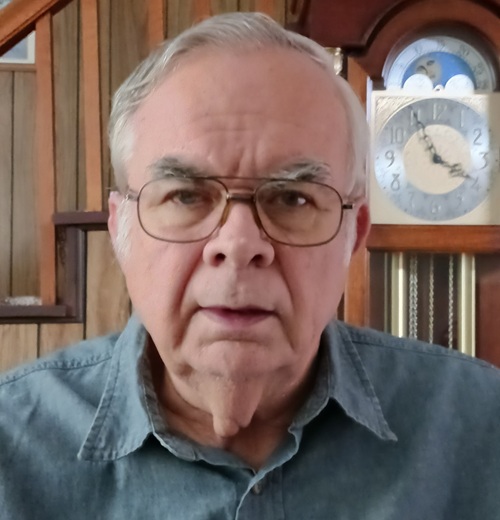
Spotlight - Dennis Bombardiere, W8YS, EAN Cycle 2 Net Manager |
|
I got my first explanation of ham radio from a ham who worked in the high school where I taught.
He explained about licenses, tests and equipment.
My wife's uncle was an amateur operator, so I arranged a visit with him, during which I heard him talk with a ham in California on 20 meters. I became very interested and went from no license to Extra class in 5 months.
As soon as I got my General ticket, I checked in to the West Virginia Fone Net.
The net control station said I had a weak signal and asked me what antenna I was using.
He said to get rid of my vertical antenna and put up a dipole.
I did and he became my Elmer -- Tom Holton, W8YP, the Fone Net Manager.
I checked in to the Fone Net almost every evening.
I enjoyed listening to stations checking in from various locations in the state as well as other states.
On one net, there was a radiogram for Fairmont.
I live a few miles from there and Tom asked me to deliver it.
When I said I didn’t know what to do, he said to get a piece of paper and he would help me, right in the middle of the net.
And so it began!
Tom was NCS 4 or 5 days a week. He needed help, and asked me to try being NCS.
After a few days of practice copying what the NCS does and all the call signs, I gave it a try.
I had 98 check-ins and 3 radiograms passed in 61 minutes. I was mentally and physically drained, but I was hooked.
I was NCS at least once and sometimes 2 or 3 days a week. When I made a mistake, Tom would quickly correct me, and I continued to learn.
I asked where the radiograms came from.
He pointed me to the NTS Manual, where I also found out about region and area nets.
Listening to those nets was confusing.
Operators were all doing it differently.
I heard a lot of confusion and errors.
I asked Tom why so many were passing traffic in different ways, and if there was a book or manual that explained how to do it correctly He said to go to EAN at 2:30 and ask Marcia, KW1U: “She is in charge of everything!” (He said not to check in to EAN until I had listened for 2 or 3 weeks, so that I would not interfere -- they have a lot of traffic to pass.) When I asked Marcia, she said work was proceeding on that issue, and when it was finished it would be published.
The ARRL NTS Methods and Practices Guidelines, also known as the MPG, came out about 2 years later. My prayers were answered.
After that, I became 8RN Manager. I had to give that up after 4 years because of an unexpected medical condition.
Work was taking my remaining stamina and I eventually retired.
Then I was able to check in to EAN Cycle 2. At that time, a lot of traffic was being passed between first and fourth region, basically between Boston and Hiddenite, North Carolina.
In the summer, propagation was very difficult for that pairing.
I was sitting about halfway between the two, and spent many hours relaying between those two and others.
I would like to thank then-Net Manager Gary Ferdinand, W2CS, for having faith in me, helping and guiding me to learn and handle NCS on EAN Cycle 2.
In February 2013, I accepted the position as EAN Cycle 2 Manager. At first, it was a little trying, as some did not want to accept the MPG or me, but when I accept a job, I will do it to the best of my abilities, not “just for the title.” Because MPG stands for the ARRL NTS Methods and Practices Guidelines, that means NTS operators are expected to follow it.
Some got upset. A few quit. But now I have EAN reps who ask me to critique their sending, which I do via email.
I also find that I am no longer adding as many procedures and reminders on monthly reports, which means we are getting better as a team.
Just as I did when I was teaching, I get a great deal of pride and satisfaction from seeing net participants learning and doing a better job of passing traffic.
My hope is that net reps will learn the proper procedures and take those back to their region and local nets, making the entire NTS better.
I do not mind any amateurs checking in to the EAN Cycle 2. They may get interested.
They may become reps -- some have. They may become a net control station or a net manager someday.
In this age of cell phones and push-button instant gratification, it is not easy to find new people to join in.
We need to keep EAN Cycle 2 and the NTS going -- and strong.
I receive emails from traffic handlers asking permission to use some of the procedures and reminders that I often include in my monthly reports, for training on their nets.
My answer is yes; it helps to make traffic handling and the NTS better.
I have had requests from traffic handlers who are not participants in EAN Cycle 2, to put them on my email list just for the traffic procedures and reminders.
I have been a Little League baseball coach, a social studies teacher, a middle-school basketball coach for boys’ and girls’ teams, and a high-school girls basketball coach.
Public service is a perfect fit for me.
|
 |
|
|
|
The National Traffic System® (NTS®) is a network of amateur radio operators who move information during disasters and other emergencies.
General messages offering well-wishes also move through the NTS® to help test the system and to help amateur radio operators build traffic handling skills.
While the NTS® is primarily set up to serve the United States and Canada, it is possible to move traffic internationally through the NTS® via various local, regional, area, and international network connections.
NTS 2.0
NTS Manual
NTS Methods and Practices Guidelines
Handling Instructions
Numbered Texts
Encoding Rules for Agency Forms
Virtual NTS Training Net
|
|
Sign Up to Receive The NTS Letter |
|
The NTS® Letter is published monthly and is free of charge to ARRL members. Subscribe: www.arrl.org/opt-in-out
If anyone has not received copies of The NTS Letter by email, be sure to check www.arrl.org/opt-in-out
to confirm that you are opted in. If you don't see The NTS Letter listed among the publications you are opted into, click on "Edit," and you will have the opportunity to check the box to receive The NTS Letter. If you have missed any issues, you can find them all at www.nts2.arrl.org/nts-letter-issues
as well as on the ARRL website.
Editor: Marcia Forde, KW1U, Section Traffic Manager -- Eastern Massachusetts, Western Massachusetts, and Rhode Island
ARRL Emergency Communications and Field Services Director: Josh Johnston, KE5MHV
|
|
NTS® is a program of ARRL The National Association for Amateur Radio®. No other organization works harder than ARRL to promote and protect amateur radio! ARRL members enjoy many benefits and services including digital magazines, e-newsletters, online learning (learn.arrl.org), and technical support.
Membership also supports programs for radio clubs, on-air contests, Logbook of The World®, ARRL Field Day, and the all-volunteer ARRL Field Organization.
|
|
The
NTS Letter is published every month (12 times each year). ARRL members may subscribe at no cost or unsubscribe by editing their Member Data Page at
www.arrl.org/opt-in-out.
Copyright © 2026 American Radio Relay League, Incorporated. Use and distribution of this publication, or any portion thereof, is permitted for non-commercial or educational purposes, with attribution. All other purposes require written permission.
|
|



