|
ARRL-RRI Message Handling Instructions Updated |
|
As most readers are aware, the preamble of the ARRL-RRI NTS Radiogram contains a field, or box, noted on the form as HX or Handling Instructions.
This is an optional field which allows the originator to specify, to any amateur radio operator relaying or delivering that message, instructions on how they want that message to be handled.
Inside that box one might expect to find a letter, such as A through G.
The list which has been in use for many years has recently been updated to reflect current times and usage. The NTS2 committee and the leadership of RRI have worked together to create a list with some new handling instructions and clarification for some older ones. This new list can be found at https://nts2.arrl.org/hx-handling-instructions/
and https://radiorelay.org/new-handling-instructions-and-arl-numbered-radiogram-texts/.
So, what is different?
HXA formerly stated: “Collect landline delivery authorize by addressee within ____ miles. (If no number, authorization is unlimited).” A collect call meant the recipient would agree to cover long-distance charges billed by the phone company.
This process would also require a long-distance operator to facilitate a call.
Obviously, now that we have cell phones and nationwide dialing this instruction becomes obsolete.
HXA now reads, “Delivery by email and/or text message preferred.”
HXD formerly stated: “Report to originating station the identity of station from which received, plus date and time.
Report identity of station to which relayed, plus date and time, or if delivered report date, time and method of delivery.” This instruction required any station involved in handling this message, whether relaying or delivering, to report to the originating station.
This would allow for tracing a message that may have gone astray during relay from origination to destination, but if used indiscriminately could clog the network.
Because it was seldom used, many traffic handlers were not familiar with how to handle it.
The NTS2 committee and the RRI leadership agreed to slightly more clarifying wording, with an admonition/reminder regarding use during disasters or periods of high demand on circuit capacity.
HXD now reads, “All stations handling this message report to originating station the identity of station from which received, plus date and time.
Report identity of station to which relayed, plus date and time, or if delivered report date, time and method of delivery.
During disasters or periods of high demand on circuit capacity, avoid using this instruction.”
Note that there is an ARL numbered radiogram which serves this purpose for reporting and makes it easier and faster to generate and send this information. See ARL Ninety Four (ARL 94) at https://nts2.arrl.org/numbered-texts/
and https://radiorelay.org/files/reference/ARL_Numbered_Radiogram_Texts.pdf.
HXG formerly stated, “Delivery by mail or landline toll call not required.
If toll or other expense involved, cancel message and service originating station.” With toll calls being a thing of the past, this instruction has become irrelevant.
However, many traffic handlers prefer not to incur the expense of today’s postal rates to mail a message, especially one that some have referred to as “unsolicited” or “non-personal.” This instruction allows for a personal choice to mail or not to mail when unable to deliver by phone or email.
Note, however, that any radiogram not delivered must elicit a “service” radiogram to the “station of origin.”
HXG now reads, “If postage or other expense involved, may cancel message and service originating station.”
HXI is a new handling instruction, to be used with the radiogram-ICS-213 type messages which might be seen during disasters or traffic tests.
This instruction reads, “Please deliver as a radiogram-ICS-213 message.”
HXR is also a new handling instruction which ensures that the addressee has received and read that message, rather than, for example, the message being left in an email or on a voicemail.
This instruction reads, “Please confirm that the addressee has read the message and reply to originator.
Reserved for Emergency, Priority and Certified precedence messages.”
HXT is another new handling instruction which will be implemented at a future date.
More information will precede its implementation.
The NTS2 committee has discussed testing performance to evaluate the health of the system and to determine where assistance or intervention may be needed.
These test messages will use this handling instruction with a message ID.
It reads, “Special traffic test message, ID _____.”
|
|
Originating and Delivering Holiday Season Radiograms |
|
James Wades, WB8SIW
There was a time, some decades ago, when traffic nets were incredibly busy with holiday radiogram traffic.
Even those who rarely, if ever, handled message traffic would often originate a holiday radiogram to family and friends separated by distance.
This was, of course, during the era before the internet and cellular phones, when distance seemed like more of an omnipresent reality than it is today.
It seems that the tradition of sending a Christmas radiogram should have a nostalgic feel that fits the holiday season well.
Furthermore, the delivery of a radiogram serves as a great public relations opportunity.
Therefore, ARRL and RRI are encouraging radio amateurs to originate a Christmas radiogram this year.
If one hasn’t originated a radiogram before, there are some convenient tools, one of which is available via the Winlink forms library and the other of which is an online radiogram portal developed by K1RFD for the ARRL NTS2 Committee. Both methods allow people who have never sent a radiogram in their lives to originate a message to family or friends.
If doing so by Winlink, one can access an interactive RRI radiogram form in the Winlink “Forms Library.” The RRI radiogram template walks you through the process of creating a properly serviced radiogram.
It will even correct you if you make a formatting error.
Once you have completed your radiogram form, you simply select the destination region for routing to the last mile and ultimate delivery.
Another option is the online “Radiogram Portal” developed by the NTS2 Committee. One fills out the required information which the software forms into a radiogram, and which is then retrieved by an NTS volunteer who injects it into the traffic system for relay to its destination and delivery. Access the portal at https://nts2.arrl.org/radiogram/.
Before originating your radiogram, please make sure you have the correct, up-to-date address information for the recipient including both a phone number and email address.
Because these are routine messages, please limit your text to 25 words or less. One may want to also consider using the ARL Numbered Radiogram Texts “ARL Sixty One” (“Wishing you a very Merry Christmas and a Happy New Year”) or “ARL Sixty Two” (“Greetings and best wishes to you for a pleasant ______ holiday season”).
Some Recommendations for Traffic Handlers
For Christmas radiograms, we are encouraging email or hard-copy delivery. This allows for the use of the new “Christmas Season Radiogram Form 1802 available in the RRI Forms Library” at https://radiorelay.org/files/2025/11/ARRL-RRI-Form-1802-Christmas-Radiogram.pdf
or on the ARRL NTS2 Web page at https://nts2.arrl.org/arrl-rri-form-christmas-radiogram-2025/.
This form has a unique holiday theme layout ideal for delivering Christmas radiograms.
The back of the radiogram form includes information on amateur radio, ARRL, and RRI, making it an ideal “advertising” tool for the Amateur Radio Service.
NTS and RRI volunteers delivering these Christmas radiograms will want to provide a quality delivery experience.
If delivering via email, simply populate the form and then print it as a PDF.
The PDF can then be appended to an email for delivery.
The PDF can also be easily converted to a JPEG for delivery via text message.
One can even deliver the form via both methods!
If delivering via USPS or in person, one should print the Form 1802 radiogram form in color (if possible) and double-sided. This places the information about the Amateur Radio Service and ARRL on the back of the form.
One can then place it in an envelope for mailing or personal delivery.
The Importance of Public Outreach
Public relations are more important than ever for the Amateur Radio Service.
Whether a message is delivered to a third party or to a local radio amateur, the holiday season allows us to advertise the fact that the Amateur Radio Service is alive and well and active in the community.
Lastly, we recommend… We recommend transmitting your Christmas radiogram early.
We don’t want our volunteers staying up until midnight on Christmas Eve trying to deliver lots of last-minute radiograms. Try selecting some random days between December 5 and December 20.
|
 |
|

|
|
|
Texting Like It’s the Jazz Age |
|
One morning earlier this month, I got a text from my dad, K3ORC, letting me know that he’d just received the QSL for his 100th contact on 80 meters. With that, he’d achieved DXCC on 8 bands. Earlier this year, he’d also reached a total of 1,000 band-countries in the ARRL’s ongoing DXCC Challenge.
It’s an impressive set of accomplishments for a ham who operates exclusively with 100-watt radios and suboptimal wire antennas.
I congratulated him by text, of course, but felt this occasion called for a little more fanfare.
Shockingly, Hallmark doesn’t seem to have any “Congratulations on your band-country total” cards. Then I thought of something more appropriate: a radiogram.
Not having interacted with ARRL’s National Traffic System (NTS) in quite a while, I did some looking around and discovered that it has evolved a bit.
In fact, there’s a whole ARRL initiative called “NTS 2.0,” which is trying out a bunch of strategies to revitalize the ham tradition of relaying messages.
I’ll just mention some of the major developments of recent years, for those who, like me, haven’t paid much attention to the NTS in a while.
First, there are now two organizations dedicated to relaying formal radiograms over the air: ARRL’s NTS program, and an independent nonprofit called Radio Relay International (RRI). Thankfully, the two groups now cooperate to run a single unified network.
The second major trend has been technological, with NTS/RRI embracing digital modes such as NBEMS and Winlink, in addition to PACTOR, VARA and packet, for a lot of message handling, while still preserving their traditional voice and CW nets.
Finally, NTS 2.0 is making a major push to integrate NTS with emergency communication groups such as ARES and RACES, and to find ways to generate more message traffic to exercise the system and its operators between disaster responses.
This gave me a plethora of options for sending my radiogram to Dad.
The quickest and easiest doesn’t even require a radio: ARRL now hosts a radiogram portal where anyone can enter their message into a web form, click a button, and inject their radiogram into the traffic system.
I have radios, though, and like to use them, so I looked at the NTS/RRI nets I could reach on the air.
There’s even a way to send a radiogram via APRS.
I decided to go old school with an HF SSB net.
To avoid making a fool of myself, I first filled out an ARRL Radiogram form.
You can find detailed instructions for the form online.
Some parts may seem a bit arcane at first, but it’s designed to ensure the message can pass through multiple operators on different modes and still arrive exactly as it was sent.
Once you get used to it, it’s pretty straightforward.
Checking into a traffic net is like checking into any other directed net.
If you’ve been on any of our local club nets, you already know the drill: listen to the net control station (NCS) and follow their instructions.
In my case, the correct procedure was to answer the call for “stations with traffic” by giving my call sign and then saying, “through one,” meaning I had one message going outside the net’s area of coverage, i.e., “through traffic.” I didn’t quite get it right, but I came close, and the NCS offered a friendly correction for next time.
Once everyone was checked in, the NCS paired me with another station who would take my traffic.
When he was ready to copy, I read my radiogram top to bottom, using phonetics to spell out call signs and abbreviations.
After you’ve listened to a few traffic nets, the procedure will become second nature.
Traffic nets are efficient, and after a few more radiograms got passed, the NCS secured the net.
The whole thing had taken about 15 minutes.
I got a text from Dad the next day thanking me for the radiogram.
He said he’d never gotten one before; I think he was tickled by the novelty of it.
And outside a major disaster, that’s a great way to think about radiograms: a fun, nostalgic novelty that also exercises our operating skills.
Sure, vessels at sea are streaming Zoom calls over Starlink satellites, Meshtastic nodes are popping up like mushrooms after a rain, and most of us have unlimited calling and texting plans on our pocket supercomputers.
That’s why Western Union doesn’t even offer telegram service anymore.
But we do, and interacting with that system is a fun way to practice important on-air skills, fit a bit of ham radio into a short window of time, and explore new operating modes, all while sending a message with some old-fashioned charm.
There are even games you can play now via radiogram. Folks have been sending chess moves through the system for years, but more recently NTS introduced a “Treasure Hunt” that anyone can join (details are at https://nts2.arrl.org/treasure-hunt/).
Whether you’re hunting for radio treasure or just sending holiday greetings or congratulations to some distant friends and family members, radiograms are a fun break from the usual communication media we use these days.
Give it a try. Operators are standing by.
Alan Dove, AB1XW, From the Hampden County (MA) Radio Association Newsletter – By permission from AB1XW, Editor
|
|
75-Meter Interstate Sideband Net (ISBN) – Independent Nets in Support of NTS |
|
Dave Sheppard, W2PAX, SFL STM
Independent nets, while not affiliated with NTS, provide a valuable contribution to the relay of radiogram message traffic, often with outlets into otherwise hard-to-reach areas. Many of their members are also associated with NTS traffic nets. This month, I would like to highlight the 75-Meter Interstate Sideband Net, which serves the US and Canada (yes, we call for Canadian stations too!). The net has been operating continuously since 1952 and can be found at 3985 kHz daily at 0100 UTC, 365 days per year, and welcomes all licensed amateurs to participate. The net is co-managed by Dennis Carlson, K9ZMI; Mike Leger, W8PQ, and Dave Sheppard, W2PAX. First-time check-ins will receive a PDF welcome card to the net. A unique part of the ISBN is its birthday radiogram program. All check-ins have the option of providing their birth month & day to a net manager, and each year will receive a birthday radiogram. It’s a great way to generate traffic across the country for the net. The ISBN website can be found at https://www.qsl.net/75misbn/. If you have 75-meter capability in the US or Canada, check it out.
|

|
|
|
The QNI Newsletter, December 2025 edition, has been published and is available at https://radiorelay.org/qni/. This very informative newsletter is edited by James Wades, WB8SIW, and is “dedicated to promoting genuine emergency communications preparedness.
It is independently published and distributed free of charge to the amateur radio and emergency management community.
The mission is to provide a forum for EmComm volunteers throughout North America.
It operates on the premise that amateur radio public service volunteers should be, first and foremost, communicators and technicians.” [RRI website]
Treasure Hunt Reminder: The November hunt is ongoing, and any amateur radio operator is invited to participate during December but must have completed the four rounds by December 25 in order to qualify for a certificate, be eligible for a drawing to receive the specially-designed coffee mug and to have their name printed in the January issue of The NTS Letter. The first-round question for the November hunt is:
“THR1 What is the name and call sign of a well-known guitarist from Beverly Hills 90210 query reply to Glenn VE1AQF Meteghan NS B0W 2J0.”
Details about how to participate can be found in previous issues of The NTS Letter which can be found at https://nts2.arrl.org/ntsletter/. The next hunt will be announced in the January 2026 edition of this newsletter.
The ARRL Eastern Massachusetts Section participated in a Simulated Emergency Test (SET), “Operation November Wind,” on November 15, 2025. NTS was an integral part of the exercise with the Massachusetts Rhode Island Digital Net (MARIDN) and the Eastern Mass 2-Meter Traffic Net (EM2MN) holding special sessions.
There were 21 participants among the two nets and six radiograms were passed.
Section Emergency Coordinator Rob Macedo, KD1CY, expressed many thanks to the two net managers, Jon McCombie, N1ILZ, and Peter Doherty, KC1HHO, and to all who participated in this mini-exercise and got some valuable experience in emergency communications.
LICW (Long Island CW Club) offers training for NTS CW traffic nets. The classes run for 8 weeks and then begin again. There is a new session beginning December 2. Check the LICW website at https://longislandcwclub.org/
for information about the club, which boasts more than 7000 members from 50 states and 68 countries. Contact Ed Conway, N2GSL (eddieconway@gmail.com), for information about the NTS class.
It’s a great way to practice and increase your CW speed while performing a public service.
ICS-213 discussion – During December, the NTS2 committee and RRI leadership will be discussing message relay and the ICS-213 form for emergency communications.
More information about this aspect of the hobby to follow in later issues.
|
|
Spotlight – Brian Jenks, W9BGJ |
|
I was introduced to amateur radio in 1990 by another gentleman with whom I had worked, Heath, who was at the time NQ9P and is now N9WV. Through his mentoring and some others in our local radio club, I was able to study for and pass my entry-level license test at an area hamfest several months later.
I came into the hobby as a Technician-class licensee at a time when CW was still a requirement to get on the HF bands.
So, back to studying I went, and about a month later, I had my 5 wpm CW endorsement. At the time, I thought I wouldn't use CW much, if at all.
I was wrong about that in a big way! After visiting a couple shacks of other operators I had come to know, I was soon on my way to becoming a General-class licensee with 13 wpm code speed to prove it.
After some fun times on 40 and 20 meters, I was able to get my first taste of DX in a contest or two.
That, coupled with the desire to become a VE, led me to take and pass my Advanced on the first try.
I'm still amazed to this day how that happened! Then, on to the elusive Amateur Extra-class operator I went, code and all, and after several attempts became an Extra Class operator.
Well, what to do other than casual QSOs, I asked myself.
That was answered one afternoon when I tuned in to the Indiana Traffic Net and was introduced to the world of traffic handling, both SSB and CW.
Truth is, between the two modes, I actually prefer CW traffic nets, not to downplay our excellent SSB traffic net, it's just my preference.
Currently in the Indiana Section, we have two very active NTS nets, the Indiana Traffic Net (ITN), which meets twice daily 365 days a year, and the Indiana Section CW Traffic Net (QIN), also meeting 365 days a year. Between the two nets, we handle 150-200 messages per month and I only see that number growing as we bring more participants on board for both nets!
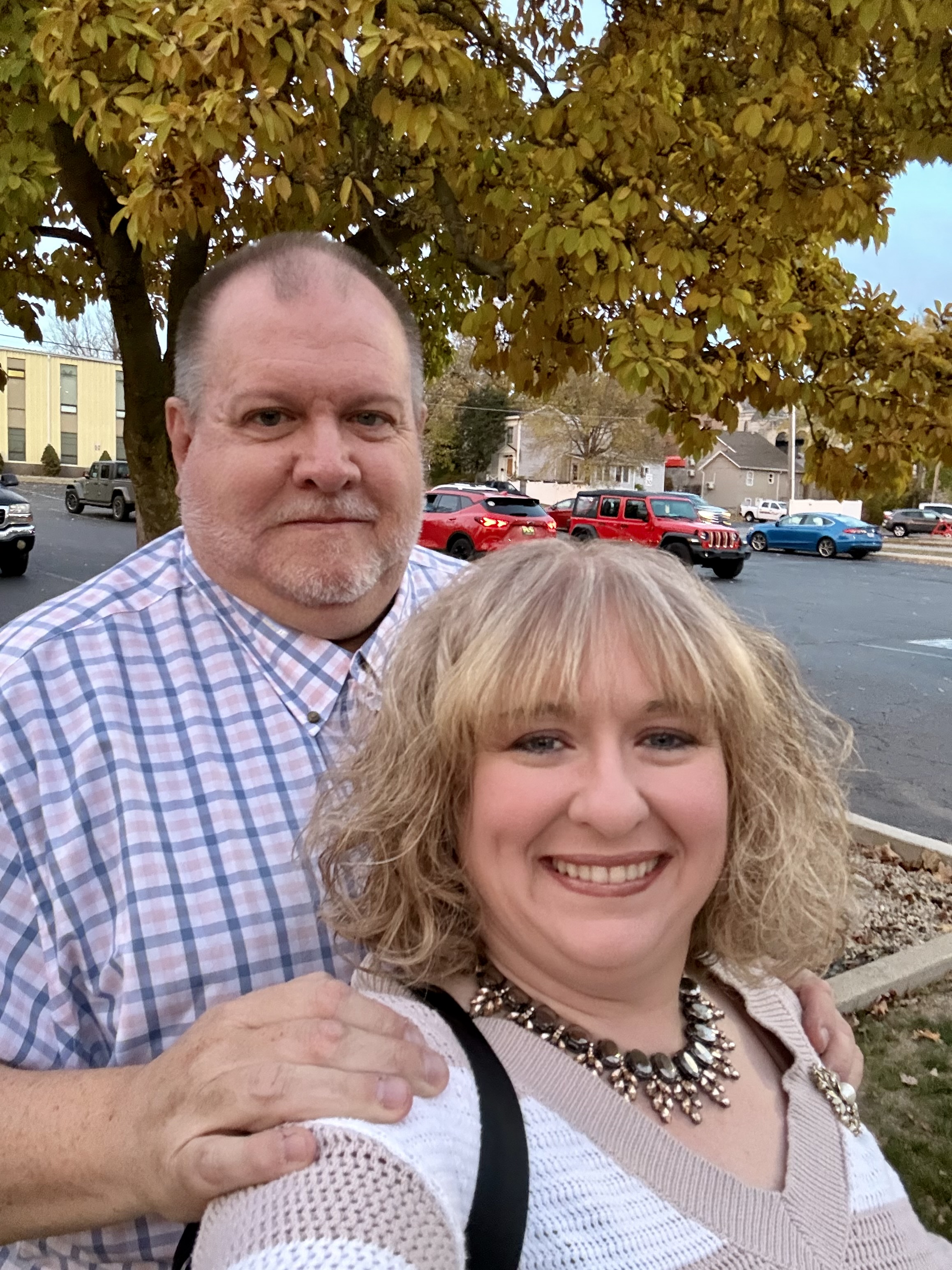
Seven years ago, I found the one thing I was missing in my life, my beautiful wife, Melanie, W9NNH. We had met each other through amateur radio and took our friendship to the next level, becoming husband and wife in April 2024. Life has been wonderful ever since.
Melanie is also active on the HF bands as time permits, and is one heck of an antenna builder.
We love to build antennas and put them on the air.
In fact, all the antennas we have in use right now for HF and VHF were built entirely from materials we had on hand.
Outside of ham radio, I am a 911 police and fire dispatcher for the Whitley County, Indiana, Sheriff's Department, a career I very much enjoy.
I've been in the law enforcement field for 26 years, beginning in 1999 working for the Indiana State Police for several years, and another sheriff's department prior to my current one for almost 20 years. I was raised in a law enforcement family so it's in my blood, so to speak.
I'm proud of the profession I'm in and plan to retire from it in the next several years.
Other interests include DX chasing and QRP operation.
I have several small radios dedicated to QRP and portable operation.
Melanie and I both enjoy it together as often as we can.
A couple of years ago, we also discovered the wonderful world of Parks on the Air (POTA) and had a lot of fun chasing POTA stations on both SSB and CW.
It's like Field Day every day of the year!
I have been the ARRL Indiana Section Traffic Manager for the past 10 years, a position I very much enjoy.
The world of traffic handling extends beyond the scope of HF as I have several VHF/UHF nets that report each month as well.
We also have a great group of dedicated traffic handlers at all levels, Section, Region and Central Area.
These operators are top-notch in their skills and abilities, and I am very proud to have them representing the Indiana Section and NTS as a whole.
Insight that I can offer for new members is simply get involved! Check into a local or Section net and you will find many operators to guide you in the art of traffic handling.
You'll find it's addictive, just like I did all those years ago! For other STMs, just listening to your fellow traffic handlers and helping new prospective members get involved in this very valuable and relevant part of the greatest hobby in the world is well worth any time spent.
73 all!
|
 |
|
|
|
ARRL's 2025 Holiday Gift Guide
is now available, featuring amateur radio equipment and station accessories from well-known businesses. The guide also includes a special offer from ARRL. 'Tis the Season! Browse and shop at tinyurl.com/arrl-holiday-gift-guide-2025
|
|
The National Traffic System® (NTS®) is a network of amateur radio operators who move information during disasters and other emergencies.
General messages offering well-wishes also move through the NTS® to help test the system and to help amateur radio operators build traffic handling skills.
While the NTS® is primarily set up to serve the United States and Canada, it is possible to move traffic internationally through the NTS® via various local, regional, area, and international network connections.
NTS 2.0
NTS Manual
NTS Methods and Practices Guidelines
Handling Instructions
Numbered Texts
Encoding Rules for Agency Forms
Virtual NTS Training Net
|
|
Sign Up to Receive The NTS Letter |
|
The NTS® Letter is published monthly and is free of charge to ARRL members. Subscribe: www.arrl.org/opt-in-out
If anyone has not received copies of The NTS Letter by email, be sure to check www.arrl.org/opt-in-out
to confirm that you are opted in. If you don't see The NTS Letter listed among the publications you are opted into, click on "Edit," and you will have the opportunity to check the box to receive The NTS Letter. If you have missed any issues, you can find them all at www.nts2.arrl.org/nts-letter-issues
as well as on the ARRL website.
Editor: Marcia Forde, KW1U, Section Traffic Manager -- Eastern Massachusetts, Western Massachusetts, and Rhode Island
ARRL Director of Emergency Management: Josh Johnston, KE5MHV
|
|
NTS® is a program of ARRL The National Association for Amateur Radio®. No other organization works harder than ARRL to promote and protect amateur radio! ARRL members enjoy many benefits and services including digital magazines, e-newsletters, online learning (learn.arrl.org), and technical support.
Membership also supports programs for radio clubs, on-air contests, Logbook of The World®, ARRL Field Day, and the all-volunteer ARRL Field Organization.
|
|
The
NTS Letter is published every month (12 times each year). ARRL members may subscribe at no cost or unsubscribe by editing their Member Data Page at
www.arrl.org/opt-in-out.
Copyright © 2025 American Radio Relay League, Incorporated. Use and distribution of this publication, or any portion thereof, is permitted for non-commercial or educational purposes, with attribution. All other purposes require written permission.
|
|