|
NTS Callout Meeting, February 2025: Recap |
|
The NTS subcommittee leadership held a callout meeting on February 4 for people interested in joining the NTS program. Moderated by Phil Temples, K9HI, the call was attended by 45-50 people, and included individuals from the Eastern, Central, and Western areas. A volunteer from Hilo, Hawaii, also joined the call.
Phil described some of the recent accomplishments of the NTS working groups, and challenges that lie ahead. He hopes to hold these callouts on a regular basis.
Approximately a half-dozen attendees expressed an interest in becoming involved in the program.
|

|
|
|
The Radiogram Portal, one of the NTS 2.0 early initiatives, has become a very popular addition to the NTS “toolbox.” There are currently approximately 100 Radiogrammers from around the country who have been authorized to retrieve radiograms from the Portal and enter them into the National Traffic System.
While designed primarily to inform the public about amateur radio messaging capabilities, the Portal has also been used by fellow amateurs who may not have been able to access a traffic net.
One of the results of this program has been the generation of third-party messages into the network, giving amateur radio operators more opportunity to practice and hone skills in message handling and net operation.
Jonathan Taylor, K1RFD, author and maintainer of the Portal, has recently made some updates to the software in response to requests from Portal users.
On the public-facing Portal, there's now a checkbox option, just before submitting a new message, entitled "Please e-mail me when this message has been delivered." When this option is in force, the Portal adds HXC to the message preamble.
There's also a new comment on the Radiogrammer Pick-up page reminding any Radiogrammer originating a message that a service message might come back indicating that the message had been delivered, and if so, to please relay it to the original sender via e-mail. To help support this, there's also a feature which makes it easy to send an e-mail back to the original sender.
While viewing a selected Radiogram from the list, a Radiogrammer can click "Send e-mail to sender;" this opens a page that sets up a custom e-mail message to be drafted, including some key information from the original Radiogram.
A problem was recently reported concerning duplicate messages received on consecutive days.
Messages marked as sent appeared again later, marked as available, and were then picked up by another Radiogrammer and sent with a different message number and station of origin.
An investigation showed an apparent use of a back button caused the problem.
Jonathan states this problem has now been fixed.
We are eternally grateful to Jonathan for his continuing involvement with this program to make it easy and fun to use.
|
|
Hello, Treasure Hunters! Sixteen stations participated in the January 2025 NTS Treasure Hunt. The following stations have successfully completed all four rounds at this point:
W1LEM Lem
KN6HXP Warren
K2MJR Michelle
KE8HKA Matthew
N7DMB David
N1CVO Shawn
KC3WHU Walt
W4BZM Michael
KA9IKK Bill
About the January Hunt
THR1, WHAT ARE THE MESSAGE CATEGORIES OF ACTIVITY IN THE SAR QUERY
Answer: ORIG, RCVD, SENT, DLVD - MPG 7.2.1 Categories of Activity
THR2 WHAT DOES ARL/RRC EIGHTY-NINE 14115 CW MEAN QUERY
Answer: Priority and/or emergency traffic being originated on ______ (frequency/mode) x request assistance with NTS/RRI liaison – ARL/RRC numbered texts
THR3 WHICH NTS2 NUMBERED RADIOGRAM IS BEST TO CONFIRM A DELIVERY OF A RADIOGRAM QUERY
Answer: ARL/RRC FORTY SEVEN - ARL/RRC numbered texts
THR4 WHERE IS THE PROWORD PHONE FIGURES USED QUERY
Answer: Used to introduce the telephone numbers in an address or signature when no zip code is present - MPG 2.1.5.2 Telephone Figures
March NTS Treasure Hunt - Remember to have your question number with your answer THR1-THR4, which means Treasure Hunt Round 1 – Treasure Hunt Round 2… On a voice net this would be voiced as “Mixed Group Tango Hotel Romeo 1”.
Question THR1
Is it mandatory to phonetically spell the last name of the addressee query.
Please send a radiogram to:
Ray Webb KB8GUN
Laurelville OH 43135
The judges will respond with a radiogram back to you within 24 hours of the receipt of your message most of the time.
Our judges are on traffic nets almost daily.
The in-transit time will vary.
So, if it has been 4 or 5 days and you have not received a reply radiogram, try sending a new one with a new message number.
If you need help with how to move traffic in and out of your section, contact your Section Traffic Manager (STM).
If you missed the official Treasure Hunt announcement in the December 2023 issue of The NTS Letter, here is a recap: This is a fun, on-air, multi-step competition in which you will respond to a "judge" with your answer to an initial clue or question via radiogram. The judge will reply via radiogram with the identity of the next judge, along with the next question or clue in the hunt. If you have any comments or suggestions, please email Dan Rinaman, AC8NP, at ac8np@ac8np.com.
|
|
Clarification on Radiogram Portal Users and “Radiogrammers” |
|
We have seen applications to become “radiogrammers” from people who are just learning about NTS and message handling, and we would like to clarify the distinction between users and “radiogrammers.” Anyone is invited to use the Radiogram Portal to send messages.
You don’t have to know how to format a message as the software will do that for you.
Once you’ve submitted your message, you don’t need to know how to get it into the network.
You needn’t be an authorized “radiogrammer” to do so. A “radiogrammer’” is one who has had training and experience in both handling radiograms and participating in traffic nets or the digital traffic network and knows how to move those radiograms through the network.
You can receive that training by contacting your Section Manager or Section Traffic Manager and participating in your local nets.
Once you have some experience, you may apply to become a “radiogrammer.”
|
|
New NTS Digital Working Group Facilitator: AB1PH |
|
The NTS Digital Working Group has a new facilitator, Don Rolph, AB1PH. Don has been involved with the digital group since its formation. An active ARES and RACES member in his local community, Don also played a key role in the development of the new ICS-213 encapsulation standards.
“The Digital Working Group will look primarily at backbone communication, not last mile issues,” said Don. “Last mile will initially be considered a normal local/regional net or NTS issue."
Don adds that digital signals have different propagation and fading behavior than communications dependent on the human ear. “These will need to be understood as part of the development and deployment process."
Recently, Don organized transcontinental tests to analyze propagation using NBEMS, or Narrow Band Emergency Messaging Software. (See Dec. 2024 NTS Letter: “A Transcontinental NBEMS Net – Preparing for Emergencies”). He will begin to assemble a team with experience in the technical issues of the digital modes, digital networking, and procedural issues with digital amateur radio nets.
“Proposals will be evaluated experimentally before considering their use in deployment,” said Don. “This will of necessity be a cooperative effort among a number of different amateur radio teams ranging potentially from RRI, FLDIGI, Winlink, VARA, and Transcontinental NBEMS teams. There will be others which will develop during the effort.”
“In the future, it is my hope that we will have the ability to send structured, forms-based messages to and from any point in the continental US in under thirty minutes.”
|
|
From the Field: Boston Cape Cod Traffic Jam, HVN Book Traffic Night |
|
For those not familiar with New Englanders’ annual trek to Cape Cod during the summer months, you must understand access to Cape Cod, other than by air, is limited to two bridges across the Cape Cod Canal.
At the same time, the Cape is known for its beautiful beaches, quaint shops and scenery, and is a highly desirable summer vacation spot.
Residents relish the quietness and scenic beauty of the “off-season” but must often somewhat curtail activities during the summer due to the significant increase in traffic, otherwise known as the Cape Cod Traffic Jam.
Peter Doherty, KC1HHO, manager of one of Eastern Mass section’s 2-meter traffic nets, the Eastern Mass 2 Meter Traffic Net, in conjunction with Cape and Islands Traffic Net manager Tim Doyle, W1TCD, capitalized on this theme and created and developed a plan to generate radiogram traffic while having a lot of fun.
Here is Peter’s story.
Traffic Jam!! – Peter Doherty, KC1HHO
Who said NTS Traffic Nets were boring? Stations from the Eastern Massachusetts 2 Meter Traffic Net (EM2MTN), Heavy-Hitters Traffic Net (HHTN) and Cape and Islands Traffic Net (CITN) have created the Boston Cape Cod Traffic Jam.
Over the past two weeks almost 30 pieces of traffic (radiograms) have been moved between Boston and Falmouth repeaters as well as the MMRA repeater network.
The Massachusetts Rhode Island Phone Net (MARIPN), an HF section net, has been the main relay for this traffic.
What happened? The idea of exchanging various fun questions about the places we live and shared interests was discussed among a few stations, and it took off from there.
We all agreed it had to work, and it did.
The internet is great for finding all kinds of information.
Messages about travel adventures, Cape Cod bus routes, and restaurant recommendations, to name a few, have certainly changed the content of the traffic.
What are the benefits? Increased traffic equals increased enjoyment of our hobby.
"Welcome to Ham Radio" radiograms will always be there, but having some variety keeps things fun.
Asking a station on Cape Cod a question about sharks is fun stuff.
Furthermore, all this traffic does what is most important: it helps relay stations and nets perfect their methods and procedures that are vital to an effective and accurate message communication function.
It also is great for recruitment.
All that with a lot of fun.
To those already involved, thank you so much for finding value in the program and getting it started with a real bang.
Any new or well-established stations that are interested please check in to your local 2-meter traffic net and ask the net manager how you can get started.
It is my hope that this concept grows to other nets and sections. If you are a net manager and want to find out how this program works, the leg work involved to get it started etc., please send me an email at KC1HHO@gmail.com.
Peter, KC1HHO
NTS Official Relay Station
EM2MTN Manager
EMA Asst Section Traffic Manager (training)
|
|
The last Tuesday of the month is Book Traffic Night on Hudson Valley Net (HVN), a local NTS traffic net in New York State.
Several years ago, we figured we would try training our people who routinely check into the net how to pick up or copy traffic without the need to pass it on or reply to it. It started with a weekly post-net explanation of each box on the radiogram.
Once all the boxes had been covered, we transitioned to a monthly “book traffic night” at the end of the regular net.
As folks check into the net, they indicate whether or not they would like to be a recipient of the book traffic by saying “yes” or “no” after giving their call sign.
When it is time for the book to be passed, Lynn KV2J dictates the common parts of a fun and/or informative message.
She then asks whether anyone needs to hear any parts of the message again.
Afterwards she proceeds to call each participant to give them their individual message number, with the recipient replying to roger the message.
It is a fun and risk-free way to help participants learn how to record a radiogram on-air and become familiar with book traffic.
The book traffic night continued for quite a while until an illness interrupted.
We started it back up again in July and have between 7 and 10 people taking the practice traffic and practicing confirming receipt of the traffic.
-- Lynn, KV2J, and Michelle, K2MJR
|
|
Official Relay Station (ORS) – an ARRL Field Appointment |
|
Many of our readers are already Official Relay Stations, yet others may not have heard about this ARRL field appointment.
What is an ORS and why would one be interested in such an appointment? ARRL, on its website, describes it this way.
“This is a traffic-handling appointment that is open to all classes of license.
This appointment applies equally to all modes and all parts of the spectrum.
It is for traffic-handlers, regardless of mode employed or part of the spectrum used.
The potential value of the skilled operator with traffic know-how to his country and community is enhanced by his ability and the readiness of his station to function in the community interest in case of emergency.
Traffic awareness and experience are often the signs by which mature amateurs may be distinguished.
The requirements and qualifications for the position include:
-
Full ARRL membership and Novice Class license or higher
-
Code and/or voice transmission capability
-
Transmissions, by whatever mode, must be of the highest quality, both technically and operationally.
For example, cw signals must be pure, chirpless, clickless, code sending must be well spaced and properly formed.
Voice transmission must be of proper modulation percentage or deviation, precisely enunciated with minimum distortion
-
Must follow standard ARRL operating practices (message form, ending signals, abbreviations or prowords, etc.)
-
Regular participation in traffic activities, either independent or ARRL-sponsored.
-
Being able to handle all record communications speedily and reliably and set the example in efficient operating procedures
-
Reporting monthly to the STM
(Section Traffic Manager), including a breakdown of traffic handled during the past calendar month (More on this in a future issue.
-
Recruitment of new hams and ARRL members is an integral part of the job of every ARRL appointee.
Appointees should take advantage of every opportunity to recruit a new ham or member to foster growth of Field Organization programs, and our abilities to serve the public.”
To become an Official Relay Station one must, of course, have received training in message protocols and net procedures.
Seek out your Section Traffic Manager for more information about training opportunities in your section.
The NTS 2.0 committee is also planning training opportunities via Zoom for those areas where training may not be available.
More on this later.
Having such a field appointment is an honor and a testament to one’s ability to serve the public in times of need.
Appointments are made through your Section Manager in consultation with the Section Traffic Manager or may be obtained by contacting ARRL.
Approximately two years ago, 160 radiograms were sent to all Official Relay Stations listed in the ARRL Field Appointment database.
Results of this exercise revealed not only where delivery problems exist, but also that the database was very much in need of an update.
Section Managers, who have access to their section’s database, with the assistance of their Section Traffic Managers are being asked to review the list for their respective sections, removing call signs of those amateurs who have become Silent Keys as well as any others who are no longer active in traffic handling.
Thanks to all for helping in this endeavor.
|
|
Spotlight: Don Rolph, AB1PH |
|
|
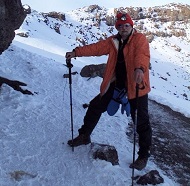
A mountaineer at heart from the age of 14, this photo of Don was taken on Mt Kilimanjaro at about 19,500 feet. | | |
Don may not be well-known to the NTS community, but he has been very active especially in emergency communications.
He has also been a regular participant and net control on the Massachusetts Rhode Island Digital Net, a section net where radiogram and ICS-213 messages are passed using NBEMS (Narrow Band Emergency Messaging Software), an open-source software suite that allows amateur radio operators to reliably send and receive data.
With ARRL’s increasing interest in emergency communications, Don’s efforts help to bring a focus to better coordination and cooperation between the NTS and ARES programs.
As noted earlier in this newsletter, Don was recently appointed as facilitator for the NTS Digital Working Group.
Here is an introduction to Don.
|
|
Don Rolph got his start in radio with a two-tube portable radio kit intended to keep him occupied when he had severe bronchitis at the age of 8. He then found a military education manual on "Essentials of Radio" in his father's bookcase, which he read cover to cover.
At that point he began first building crystal sets and then small transistor radios and other electronic projects.
This led him to get his novice license (WH6EHQ) when he was 11. His license expired and other interests took up his time.
In the middle 70s, he again got an amateur license (WA2CNM) only to have it lapse again due to conflicting priorities.
Finally in 2011 he again passed his license exam as AB1PH and has not looked back.
Amateur radio was foundational to Don's interest in technology, and he received first his bachelor's in engineering in 1973 and then his doctorate in engineering in 1983.
Don has been very active in emergency management, being a member of the Civilian Emergency Response Team in Walpole MA.
His focus has been on emergency communications and in particular digital communications over RF.
Don is active in the Norfolk County Emergency Preparedness net, the Norfolk County Radio Association net, the Massachusetts Rhode Island Digital Net affiliated with NTS, and the New Hampshire Digital training net.
Don also helps coordinate the Massachusetts Emergency Management Agency monthly amateur radio nets (80-meter voice, 80-meter NBEMS, VHF, and Winlink nets). Don helped establish, and is very active in, the Transcontinental NBEMS net which meets weekly to practice sending messages across the continental US.
Don has also been active in APRS participating in the Appalachian Trail Golden Packet activity and developing the APRS Appliance, an open-source design for an APRS controller.
We look forward to the efforts of Don and the team he is building to update ARRL emergency communications capabilities in line with service agencies’ needs. If anyone is interested in working on Don’s team, you are encouraged to contact Don at ab1ph@arrl.net.
|
|
The National Traffic System® (NTS®) is a network of amateur radio operators who move information during disasters and other emergencies.
General messages offering well wishes also move through the NTS® to help test the system and to help amateur radio operators build traffic handling skills.
While the NTS® is primarily set up to serve the United States and Canada, it is possible to move traffic internationally through the NTS® through various local, regional, area, and international network connections.
NTS 2.0
NTS Manual
NTS Methods and Practices Guidelines
Handling Instructions
Numbered Texts
Form Encoding Rules for Form
|
|
Sign Up to Receive The NTS Letter |
|
The NTS® Letter is published monthly and is free of charge to ARRL members. Subscribe: www.arrl.org/opt-in-out
If anyone has not received copies of The NTS Letter by email, be sure to check www.arrl.org/opt-in-out
to confirm that you are opted in. If you don't see The NTS Letter listed among the publications you are opted into, click on "Edit," and you will have the opportunity to check the box to receive The NTS Letter. If you have missed any issues, you can find them all at www.nts2.arrl.org/nts-letter-issues
as well as on the ARRL website.
Editor: Marcia Forde, KW1U, Section Traffic Manager -- Eastern Massachusetts, Western Massachusetts, and Rhode Island
ARRL Director of Emergency Management: Josh Johnston, KE5MHV
|
|
NTS® is a program of ARRL The National Association for Amateur Radio®. No other organization works harder than ARRL to promote and protect amateur radio! ARRL members enjoy many benefits and services including digital magazines, e-newsletters, online learning (learn.arrl.org), and technical support.
Membership also supports programs for radio clubs, on-air contests, Logbook of The World®, ARRL Field Day, and the all-volunteer ARRL Field Organization.
|
|
The
NTS Letter is published every month (12 times each year). ARRL members may subscribe at no cost or unsubscribe by editing their Member Data Page at
www.arrl.org/opt-in-out.
Copyright © 2025 American Radio Relay League, Incorporated. Use and distribution of this publication, or any portion thereof, is permitted for non-commercial or educational purposes, with attribution. All other purposes require written permission.
|
|