|
|
Radiogram Blitz: Promoting the NTS Letter |
|
You have no doubt seen a blitz of radiograms from KW1U promoting The NTS Letter. We have been somewhat surprised to learn that there are many traffic handlers who have not heard of The NTS Letter. This is an effort to get the word out to those folks.
A total of ORS appointees from the ARRL Field Appointment Database showed a total over 650 from throughout the country.
Radiograms to all 650 are currently being sent, approximately 50 per day, and will continue until completion.
We acknowledge that some addressees will be Silent Keys and others will have been inactive for many years.
As mentioned later in this issue, an effort is about to be made to update the list of NTS appointees in the ARRL database.
Many thanks to all who have been expediting these radiograms.
|
|
NTS and Hurricanes Helene and Milton |
|
I was interested to hear if there was any NTS welfare traffic seen during the recent devastating hurricanes in North Carolina and Florida and points between.
Here are some comments from the Section Traffic Managers of those areas.
From North Carolina STM Dave Roy, W4DNA:
Most of the H&W traffic that I am aware of came in via digital, and that wasn’t a lot. I understand that some of the ARES group set up shop on 40 meters and moved some H&W traffic. They even put out a call for help but turned down NTS operators.
H&W inbound traffic should be delayed for the first 72 hours post-incident.
The local responders need time to get established and be able to set up an initial response.
Hams need time to recover as well.
There were many antennas down and power was unstable to non-existent. The type of environment/topography involved presented a different situation than what is experienced at the coastal flatlands.
It is much like the environment experienced in the California wildfires – uneven mountainous terrain presented difficulties in radio communications.
And of course, the water flow is significantly more powerful than the coastal environment – maybe would be more comparable to the coastal surges than coastal flooding.
From West Central Florida STM Dave Rockwell, W4PXE:
We didn't have any welfare traffic in West Central Florida.
We concur that incoming welfare inquiries should be postponed for 48 to 72 hours.
Most of our counties did not lose cell coverage.
Many of the folks in our Section notified friends and family through text or social media.
From North Florida STM Helen Straughn, WC4FSU:
I have not received any particular stories about Northern FL issues.
I can say that 48 to 72 hours is somewhat reasonable for our areas of lesser damage; a lot of our power and telephone services had been restored by then, in these outer bands of damage, with individual pockets of outages remaining for more days.
I have been surprised by the number of large trees down in the Volusia and Flagler County areas.
From South Florida STM Dave Sheppard, W2PAX:
Oddly, I didn’t handle any welfare traffic for Florida during any of the recent storms.
However, I’ve handled quite a bit of welfare traffic for North Carolina via the DTN (Digital Traffic Network). Due to the devastation in NC and the complete loss of communication circuits in many areas, it was extremely important to be measured in passing the welfare traffic into the affected area.
It took quite a while even for the amateur radio network to get positioned to handle traffic.
Not because they were unprepared, but the level of destruction was far beyond what anyone could have reasonably expected.
At 4-5 days in, I was hearing from operators that passing traffic was still sluggish as they tried to find outlets.
|
|
NTS Training via Zoom Held October 14 |
|
A training session on the National Traffic System was conducted via Zoom on October 14, 2024, as noted in the October issue of The NTS Letter. More than 81 amateurs from around the country attended this session, which included an introduction to NTS, its purpose and structure, an introduction to the radiogram and how to effectively send a radiogram on a traffic net, plus related information such as ARRL numbered radiograms, SAR and PSHR reporting, and the ORS field appointment. The session was organized by Western Massachusetts Section Manager Ray Lajoie, AA1SE. He was assisted by Bob Sparkes, KC1KVY; Shawn Dodds, N1CVO, and Marcia Forde, KW1U. Videos used during this training session can be found on the NTS2 website at https://nts2.arrl.org/promo/, and can be downloaded for personal use or presentations at group gatherings such as club meetings, ham expositions, etc.
This Zoom call was found to be an effective way to reach people with an interest in message handling.
A follow-up is being considered.
|
|
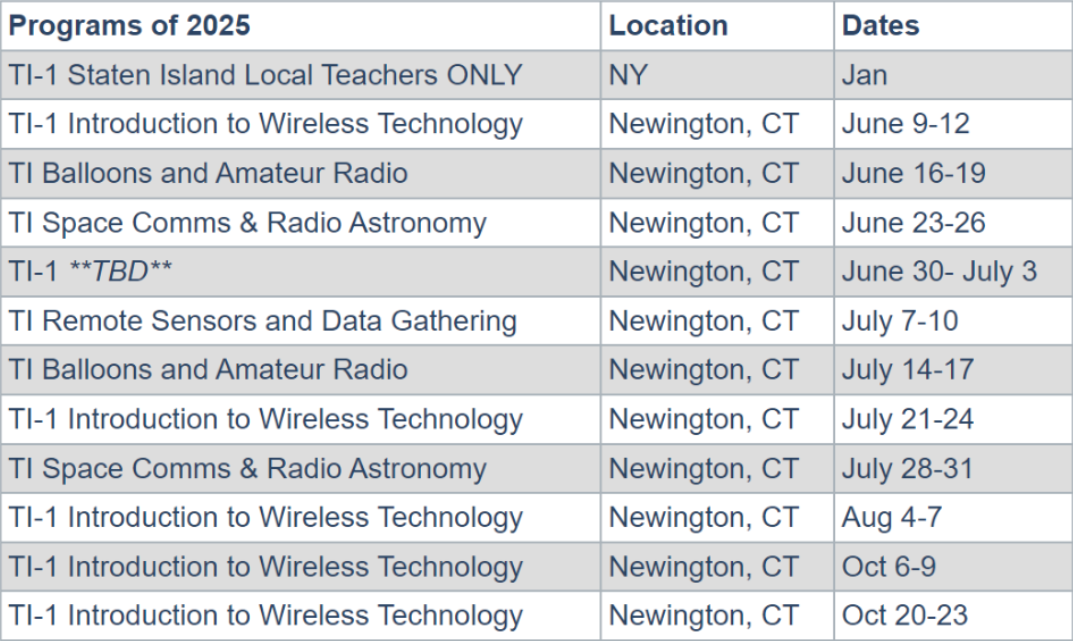
I believe we can all agree we need more traffic handlers. Many hams either have never heard of NTS or have not considered it to be relevant in today’s modern world of technology. However, this modern world comes with a certain fragility with its increasingly extreme weather patterns and a reliance on an internet which is ever subject to hackers with an ability to shut it down. The FCC has given amateur radio operators a wide range of frequencies in part due to our availability for public service. Is the ham community prepared? How can we disseminate the word, not only about the need for skilled traffic handlers, but that training is available and where to find it? As mentioned in the September issue regarding the Northeast HamXposition, the NTS 2.0 teams have prepared a flyer which can be downloaded with your local information such as how to find local nets on the opposite side. These can be passed out at club meetings, Field Day sites, conventions and any other group gatherings. You can find this flyer along with other promotional material at https://nts2.arrl.org/promo/. A copy is shown here.
|
|
|
|
|
Field Appointments and Efforts to Update a Database |
|
Old-time traffic handlers are familiar with Field Service Appointments awarded to traffic handlers for service such as an Official Relay Station or Net Manager, Section Traffic Manager, and Assistant Section Traffic Manager. It was an honor to receive one of these sought-after certificates of recognition. A recent survey of the ARRL database of these appointees, however, found that it was very out of date. Some appointees listed had become Silent Keys and others had been inactive for many years. Information about qualifications for obtaining these appointments can be found at https://www.arrl.org/field-organization. The NTS2 committee feels it is important to reward those who give their time and skills to further the mission of the NTS and encourages the awarding of these as well as other awards mentioned in the August NTS Letter to deserving amateurs.
The rollout of these awards is imminent.
Meanwhile, an effort to update this database is currently being made.
Emails will soon be sent to all Section Managers and Section Traffic Managers with a list from the ARRL database of Field Appointees in their respective sections.
They will be requested to confirm who is active, inactive, or Silent Key.
Appointments will be deleted for any who are no longer active.
|
|
Hello, Treasure Hunters! Twenty stations participated in the September NTS Treasure Hunt.
The following stations successfully completed all three rounds:
1st W1LEM, Lem
2nd VE1IJ, Glenn
3rd N1CVO, Shawn
4th N3KRX, Jerry
5th W4BZM, Mike
The first-place finisher in the September Treasure Hunt will be awarded a specially-designed mug courtesy of the NTS 2.0 Planning Committee. The other finishers will receive a certificate courtesy of the NTS 2.0 Treasure Hunt committee via email.
Mug Award Change:
In previous Treasure Hunts, a special mug was awarded to the first Hunter to finish the hunt.
We received feedback that sometimes radiograms are inexplicably delayed, and a Hunter may end up not finishing first despite their diligence during the Hunt.
Starting with the November Hunt, the mug will be awarded in a random drawing from all Hunters who complete the Hunt.
Where’s My Radiogram?
How to track the radiogram message path through NTS.
Each radiogram is relayed through the National Traffic System (NTS), which is a network of amateur radio operators.
The message is passed from one operator to another until it reaches its destination.
If you need to trace a specific radiogram, you can contact NTS operators who participated in relaying the message.
They can provide details about the message’s journey. There are many problems that can delay and/or stop a message from getting to its destination.
Messages can get to a relay station and before that station can handle it something happens to that operator (radio problems, medical, and life). There can also be software malfunctions.
And the list goes on.
The judges will respond with a radiogram back to you within 24 hours of the receipt of your message most of the time.
Our judges are on traffic nets almost daily.
The in-transit time will vary.
So, if it has been a few days and you do not receive a reply radiogram try sending a new one with a new message number.
Try to learn about the NTS in your Section.
Who is your Section Traffic Manager (STM)? The STM can answer your questions on how to move traffic in and out of your Section.
On To the November Question
We have a new judge from Canada, Glenn Killam, VE1IJ. He asks:
THR1 DURING AN NTS NET
WHICH STATION DOES NCS CALL
FIRST WHEN SENDING STATIONS OFF
TO PASS TRAFFIC QUERY
Send your radiogram entries to:
Glenn Killam, VE1IJ
Saint Alphonse NS B0W 2J0
Canada
Best Regards
Dan Rinaman, AC8NP
If you missed the official Treasure Hunt announcement in the December 2023 issue of The NTS Letter, here is a recap: This is a fun, on-air, multi-step competition in which you will respond to a "judge" with your answer to an initial clue or question via radiogram. The judge will reply via radiogram with the identity of the next judge, along with the next question or clue in the hunt. If you have any comments or suggestions, please use the survey form
or email Dan Rinaman, AC8NP, at ac8np@ac8np.com. See also https://nts2.arrl.org/treasure-hunt/
|
|
At last count, there were over 75 registered “radiogrammers” on the Radiogram Portal.
So how active has it been, you may ask? Here are a few statistics:
(Month, Messages Sent, By Number of Radiogrammers)
October, 33, 12
September, 68, 16
August, 98, 10
July, 17, 10
June, 18, 6
May, 29, 11
Generally, it appears the same group of radiogrammers shows up each month and we are very thankful for those who do. Are there those who forget to check or who check and don’t find messages to pick up? Would it be helpful to receive an email informing you when messages are listed from your regions? Of course, it would be nice to see more traffic. While it would be great to see more messages from the public showing them what amateurs can do in an emergency, hams can also use the portal to send messages they are unable to get onto traffic nets or allow newer traffic handlers to get some practice generating radiograms and sending them on traffic nets. See https://nts2.arrl.org/radiogram/
for how to send a message via the Radiogram Portal and spread the word.
It’s a useful tool, and it’s fun!
|
|
NTS 75th Anniversary — Part 3
“The (in)famous net control sheet”
By Bud Hippisley, W2RU
|
|
The initial NTS schedules announced in 1949 allocated 45 minutes ending at 9:15 p.m. local time for each Area Net, followed by 45-minute late Region Net sessions ending at 10:00 p.m., when late Section Nets fired up.
Despite this limitation, Area Nets sometimes kept going for 60 minutes or longer in order to clear all the traffic on sessions with larger traffic lists.
In early 1950, Region Net managers in the Eastern Area agreed with George Sleeper, W2CLL (who had just succeeded “Doc” Hayes, W1BYF, as EAN manager), that a more appropriate time allocation was 60 minutes for EAN and 30 minutes for the associated Region Net late sessions.
Apparently, this discussion was occurring in the other Areas as well, because it soon became the NTS standard.
During NTS’s first three decades, the Eastern Area officially included six Regions: five in the eastern time zone of the USA plus one for eastern Canada.
After adding TransContinental Corps (TCC) reps for outbound CAN and PAN traffic and possible inbound reps from those two Areas, there were often a dozen or more stations for the net control station (NCS) to coordinate. And when traffic loads increased — especially each December and during SETs and large-scale disasters — even more Region Net and TCC personnel were likely to appear!
When I first became a substitute EAN NCS in the late ’50s, I listed stations in chronological order of check-in on an ordinary sheet of lined paper, with each station’s traffic list written out (e.g., 1RN – 3, 4RN – 2, CAN – 5, etc.) to the right of his or her call.
But even on nights with “only” moderate amounts of traffic on hand, it became clear that my simple log sheet wasn’t my friend, and I began a search for a better tool.
Someone (perhaps W1NJM himself) put me on to a version of a matrix form, which I immediately adopted and have since modified in small ways for my own use over the years.
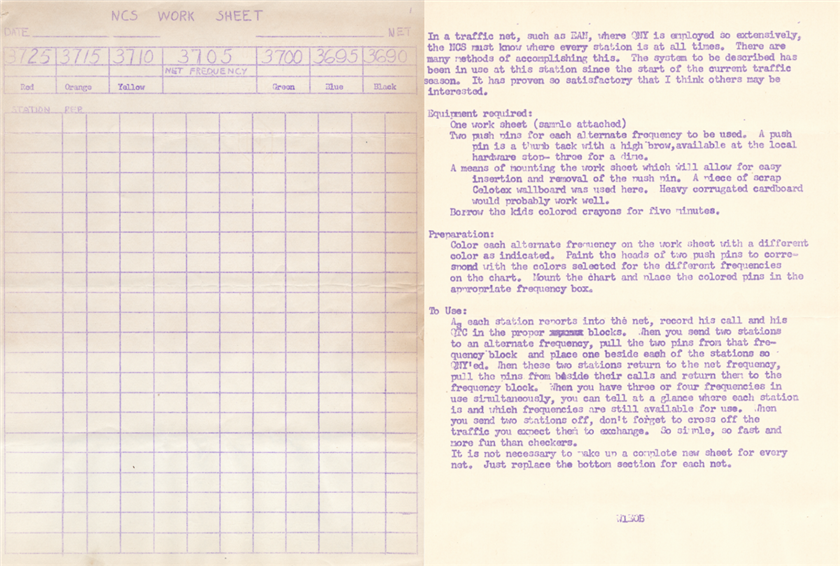
While reading some of the early EAN bulletins and correspondence between W1NJM and W2CLL, I was amazed to learn that during its first year or so, EAN cleared more than 100 messages on multiple occasions, including one session of 165! No wonder, then, that in early 1950, newly appointed Assistant EAN Manager Vic Paounoff, then W1EOB (later N4XR, now SK), convinced W2CLL to circulate a “matrix” net control form that Vic had originally created to help himself be a better EAN NCS.
However, it wasn’t until this summer that I actually came across a copy of W1EOB’s original NCS form and instruction sheet (see nearby images) distributed with W2CLL’s February 1950 EAN bulletin! (Note that EAN was on 3705 kHz in 1950, shifting to 3670 in mid-1951 when the Novice license came into being.)
|
 |
|
|
NTS W1EOB NCS Sheet (Left) NTS W1EOB Matrix Text (Right) | | | |
|
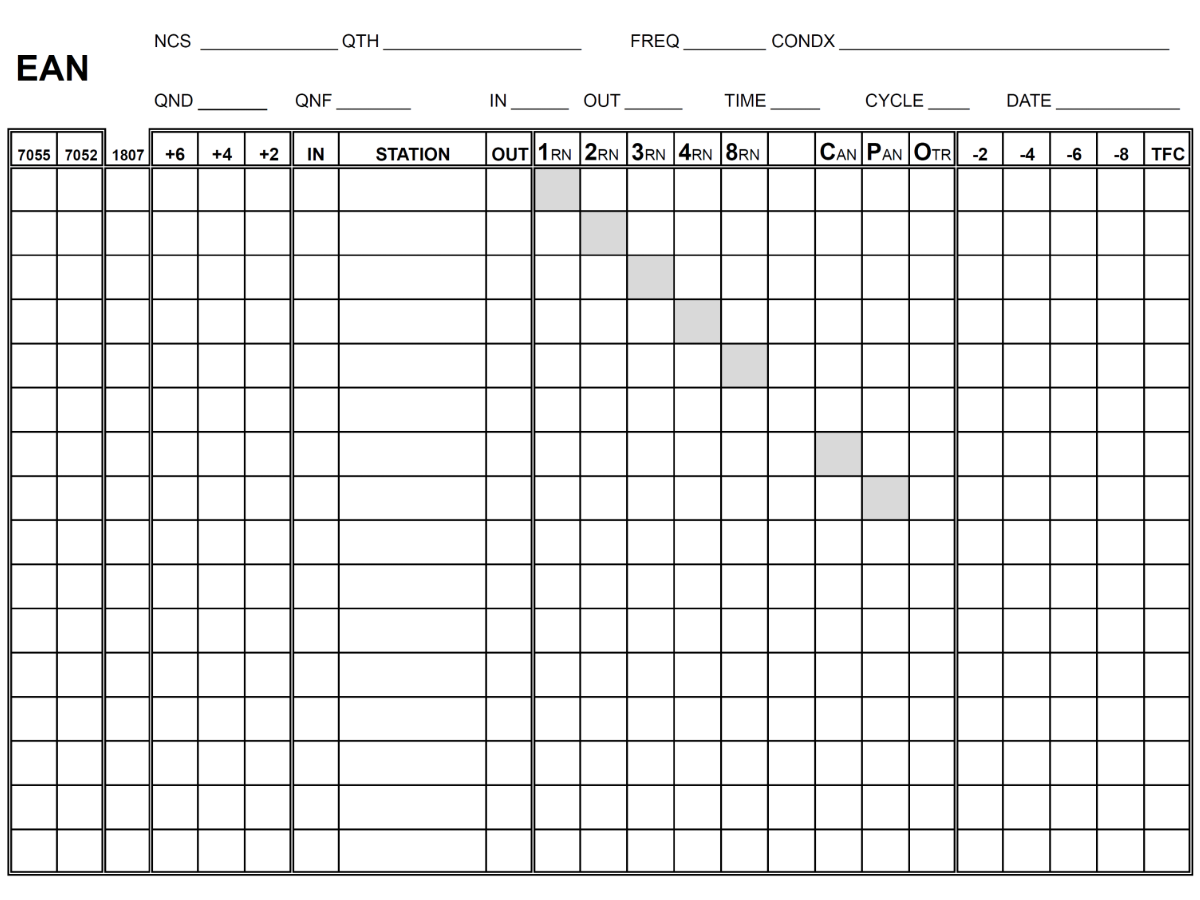
All versions of the matrix NCS sheet I have seen share core features: Each row of the form is dedicated to a specific station in the net.
Generally, data entry cells in a row of the matrix depict for that station its call sign, (optionally) QNI and QNX times, and listed traffic broken down by Region or other Area destinations.
Flanking those columns are others for the net frequency and multiple side frequencies where individual pairs of stations are sent to pass traffic.
(At the Area Net level, it is almost always wasteful of scarce time to pass traffic on the net frequency.)
In recent versions of my NCS aid (see attached), I pre-assign the first eight rows to the first Receive (or Transmit/Receive) station checking in from each of the six Region Nets and the two outbound TCC functions (Alpha and Bravo). After that, entries are usually in chronological order.
Each station in the net is represented by an 8-32 hex nut (or other token) that remains on the Net column unless it is placed on a side frequency square whenever that station is sent there by the NCS to transmit and/or receive traffic. In time, most who use the hex nuts become adept at the “two-finger slide” whereby two fingertips of the non-sending hand simultaneously move any two tokens that are “parked” on the net frequency column to a shared side frequency in a single fluid motion even while sending CW with the other hand!
|
 |
|
|
|
Part 4 of this 75th Anniversary series will discuss historical sidelights and some interesting implementations of the matrix NCS form.
|
|
Spotlight – Dan Rinaman, AC8NP |
|
I live in Tiffin, Ohio, located in Seneca County, with my wife Deb. We raised three boys here and have two grandchildren.
|
|
My introduction to amateur radio started when I was in the USMC repairing and maintaining F4B aircraft. I was in a group of CB radio operators and in this group, I met the MARS radio operator for Kaneohe Bay Marine Corps Air Station Hawaii.
He took me into the radio station and taught me how to use the teletype (MARSGRAMS) and operate phone patches on HF radio.
His wife was friends with a young lady who came out for a visit.
That visit developed into her and I getting married.
When my unit deployed to Japan, I then used the message and phone patch system of MARS to stay connected with my wife.
|
|
Fast forward 34 years. I found myself as a Boy Scout leader in need of an emergency preparedness drill for my scouts to earn a badge.
I found the Seneca County ARES group and that worked out great and we had a weekend of fun and education.
I was reintroduced to amateur radio.
In 2011, I started my amateur adventure.
I have worked up to Amateur Extra.
The Seneca Radio club and Seneca County ARES have been great at showing all the great opportunities amateur radio has to offer.
I have served in all positions in our club and hold an AEC position in Seneca County ARES.
I serve as the Database Manager for both the Ohio Single Sideband Net and Ohio ARES Training.
I have been a traffic handler with OSSBN since 2015 and became an NTSD/DTN station in 2023. During the past two years, I have been on the ARRL NTS2.0 committee helping look for ways to improve the NTS.
— Dan Rinaman, AC8NP
You may note also that Dan has been the leader of the group conducting the bi-monthly NTS Treasure Hunt, reported on in this newsletter.
He has also recently been appointed Ohio Section Traffic Manager following the retirement of David Maynard, WA3EZN.
|
|
The National Traffic System® (NTS®) is a network of amateur radio operators who move information during disasters and other emergencies.
General messages offering well wishes also move through the NTS® to help test the system and to help amateur radio operators build traffic handling skills.
While the NTS® is primarily set up to serve the United States and Canada, it is possible to move traffic internationally through the NTS® through various local, regional, area, and international network connections.
NTS 2.0
NTS Manual
NTS Methods and Practices Guidelines
Handling Instructions
Numbered Texts
Form Encoding Rules for Form
|
|
Sign Up to Receive The NTS Letter |
|
The NTS® Letter is published monthly and is free of charge to ARRL members. Subscribe: www.arrl.org/opt-in-out
If anyone has not received copies of The NTS Letter by email, be sure to check www.arrl.org/opt-in-out
to confirm that you are opted in. If you don't see The NTS Letter listed among the publications you are opted into, click on "Edit," and you will have the opportunity to check the box to receive The NTS Letter. If you have missed any issues, you can find them all at www.nts2.arrl.org/nts-letter-issues
as well as on the ARRL website.
Editor: Marcia Forde, KW1U, Section Traffic Manager -- Eastern Massachusetts, Western Massachusetts, and Rhode Island
ARRL Director of Emergency Management: Josh Johnston, KE5MHV
|
|
NTS® is a program of ARRL The National Association for Amateur Radio®. No other organization works harder than ARRL to promote and protect amateur radio! ARRL members enjoy many benefits and services including digital magazines, e-newsletters, online learning (learn.arrl.org), and technical support.
Membership also supports programs for radio clubs, on-air contests, Logbook of The World®, ARRL Field Day, and the all-volunteer ARRL Field Organization.
|
|
The
NTS Letter is published every month (12 times each year). ARRL members may subscribe at no cost or unsubscribe by editing their Member Data Page at
www.arrl.org/opt-in-out.
Copyright © 2024 American Radio Relay League, Incorporated. Use and distribution of this publication, or any portion thereof, is permitted for non-commercial or educational purposes, with attribution. All other purposes require written permission.
|
|
| |
| | | |