|
|
"Happy 75th, NTS®!" (Part 1)
Bud Hippisley W2RU |
|
October 2024 marks the 75th anniversary of the National Traffic System®. When I peruse net bulletins and correspondence that accompanied the birth and infancy of NTS®, I am amazed the system even survived the early years! Of course, not only did it survive, it went on to thrive in subsequent decades! As George Hart, W1NJM, wrote later in the '50s, it did so not because HQ attempted to force it on amateurs but, rather, because of the "dogged determination" of a majority of traffic handlers of the day.
This month and next, I'm describing a few of the challenges NTS® faced at the beginning.
October 1st was the target date publicized in September 1949 QST, but — because traffic nets of the era generally only formally operated Monday through Friday local time — full-up system operation began on the evening of Monday, October 3rd (which, of course, was really October 4th UTC). That's when the four newly appointed area net managers had agreed to hold their nets' first sessions, and most region net managers were planning to start as well.
Nearly all section nets were already in existence; all that becoming part of NTS® required of them was to assign representatives to take out-of-section traffic to the new region net each weekday evening and bring back incoming traffic later that evening.
"Doc" Hayes, W1IIN / W2BYF, the first EAN manager, saw to it that EAN led off at 0130z that Monday evening on 3705 kHz. (EAN moved to 3670 on July 30, 1951, shortly after creation of the 3700-3750 kHz Novice band by the FCC.) The other three area nets (Central, Mountain, and Pacific) followed with their initial sessions one, two, and three hours later, on 3670, 3540, and 3670, respectively.
Yes, that's right — four area nets! That's because the original NTS® plan included a Mountain Area Net (MAN) so that each time zone in the "Lower 48" had its own daily cycle of section, region, and area net operations based on "local" time. But in the Mountain time zone in 1949, nets at all levels struggled, thanks primarily to sparse population density, few active traffic handlers, and abysmal HF propagation.
To that last point: The start-up of NTS® in October of 1949 could not have come at a worse time: HF conditions from then through at least the fall of 1952 were "the pits"! Two years in a row, EAN Manager George Sleeper, W2CLL, who replaced W2BYF in December of '49, wrote to W1NJM that he could not remember conditions ever being as bad in his entire ham career! Sunspot Cycle 18 was approaching its nadir and Cycle 19 — the strongest and best of all the sunspot cycles we older hams have had the privilege of enjoying — had not yet begun to ramp up.
Winter long-skip zones afflicted even the relatively well-staffed EAN, which often had to rely on helpful CAN operators for intra-EAN relays between reps.
So, when most of the country shifted to daylight saving time in the spring of 1950, the managers of PAN and MAN found it best to officially move those nets to 40 meters until the return of standard time in the fall.
But in May of 1950, MAN's manager chose to stay on Standard time rather than meet at 8:30 p.m. MDT, which would have been an hour earlier relative to “sun time” or UTC, as System sequencing anticipated.
Suddenly, MAN and PAN were meeting at the same time and handling their traffic in what quickly became a single PAN session each evening.
After reviewing the realities of the Mountain time zone activity and staffing with the affected net managers, W1NJM removed MAN from the NTS® structure and reassigned each region net in the Mountain time zone to CAN or PAN, as appropriate.
[To be continued next month.]
|
|
Treasure Hunt Update
Dan Rinaman, AC8NP |
|
Hello, treasure hunters! Twenty stations participated in the July NTS Treasure Hunt.
The first-place finisher in the July Treasure Hunt, as well as in future treasure hunts, will be awarded a specially designed mug courtesy of the NTS® 2.0 Planning Committee. The other finishers will receive a certificate courtesy of the NTS 2.0 Treasure Hunt Committee.
On With the Hunt
The NTS® Treasure Hunt for September round #1: What radiogram information is essential for transmission on the Digital Traffic Network?
Send a radiogram through NTS® to Ray Webb, KB8GUN, Laurelville, OH 43135. The text of the radiogram should consist of the word “THR1” meaning “TREASURE HUNT ROUND 1," followed by your answer.
Be sure to format the message properly, with the message number, the station of origin, and the correct check.
You will receive a confirmation radiogram back with the next clue or question and addressee; or a message explaining that your answer is incorrect and to please try again.
The judges send their messages via Digital NTS®, voice nets and CW nets.
The relay stations may use other methods to deliver the message to you.
We use your QRZ information so it may go to your email in some cases.
Check your spam messages.
You can use OP notes to help direct a path to you (phone #, traffic nets).
The judges do not monitor their personal Winlink accounts for this exercise; they are on NTS® and NTSD nets almost daily.
Your THR1 message must be received by September 30th to be responded to.
There is a new tool you may use to send your radiogram, via the Radiogram Portal.
The NTS 2.0 Radiogram Online Tool
Good luck!
If you missed the official Treasure Hunt announcement in the December, 2023, issue of The NTS® Letter, here is a recap: This is a fun, on-air, multi-step competition in which you will respond to a "judge" with your answer to an initial clue or question via radiogram. The judge will reply via radiogram with the identity of the next judge, along with the next question or clue in the hunt. If you have any comments or suggestions, please use the survey form or email Dan Rinaman, AC8NP, at ac8np@ac8np.com. 73, Dan, AC8NP
|
|
NTS® at the New England HamXposition |
|
A very successful annual New England Division HamXposition was held August 22-25. Beautiful New England weather helped bring many hams to Marlborough, Massachusetts, where they enjoyed meeting with friends, attending a wide variety of forums, and picking up some new and not-so-new goodies from the vendors and the outdoor flea market.
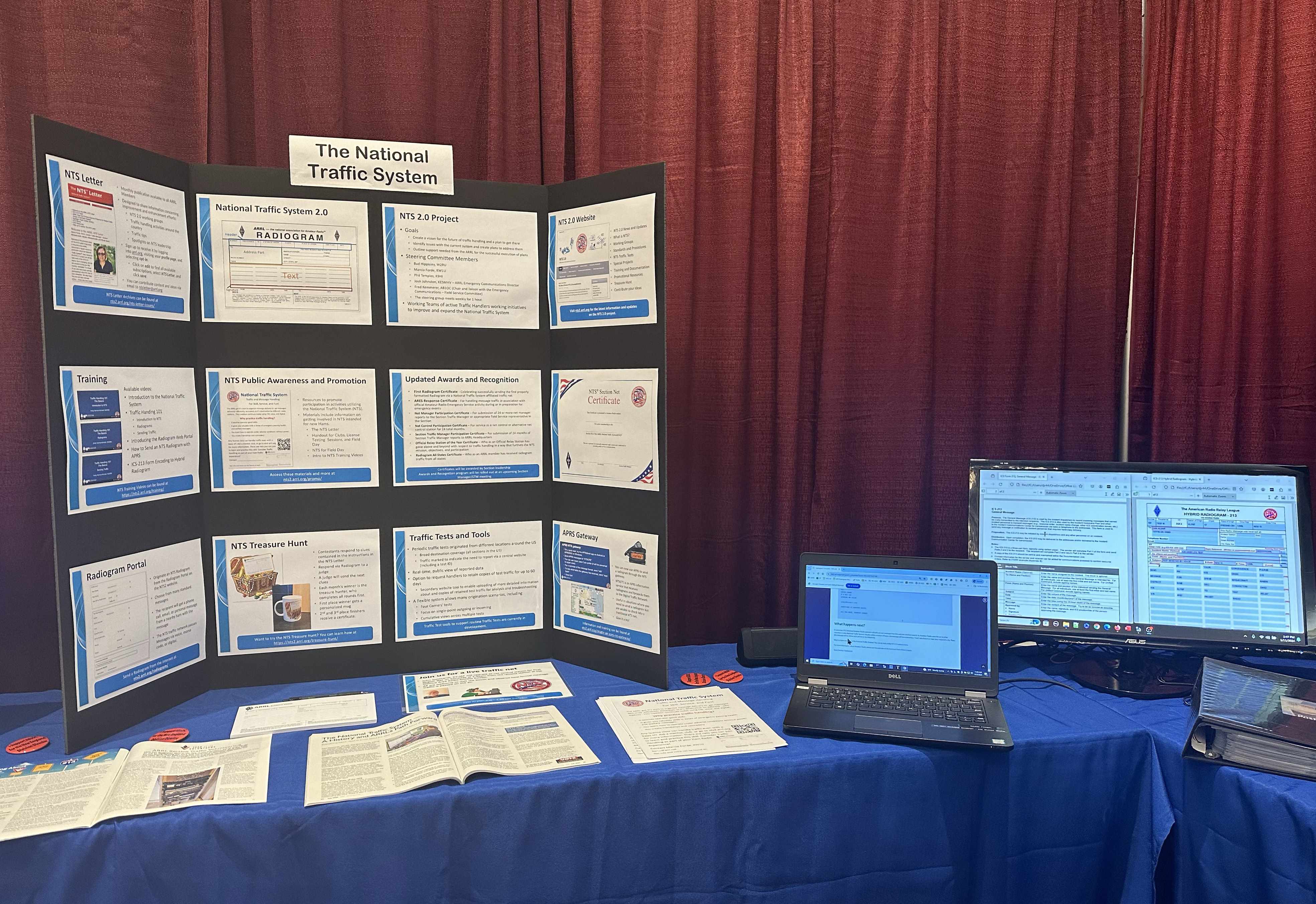
Most noteworthy for traffic handlers was an extensive display by the Nashua (NH) Area Radio Society highlighting NTS 2.0 and some of its accomplishments. A trifold pictured the NTS2 website, The NTS Letter, training videos, a downloadable handout available for clubs and public gatherings, the Radiogram Portal, the APRS to NTS Gateway and more.
|
 |
|
|
A display at the New England HamXposition presented by the Nashua (NH) Area Radio Society highlighting the National Traffic System | | | |
|
In addition, a monitor featured a continuously playing video describing information available on the NTS 2 website. A laptop with the Radiogram Portal software installed was set up to allow visitors to send radiograms to friends and family as local hams were available to assist.
Handouts were also available promoting amateur radio to the public and which also included a list of traffic nets throughout New England.
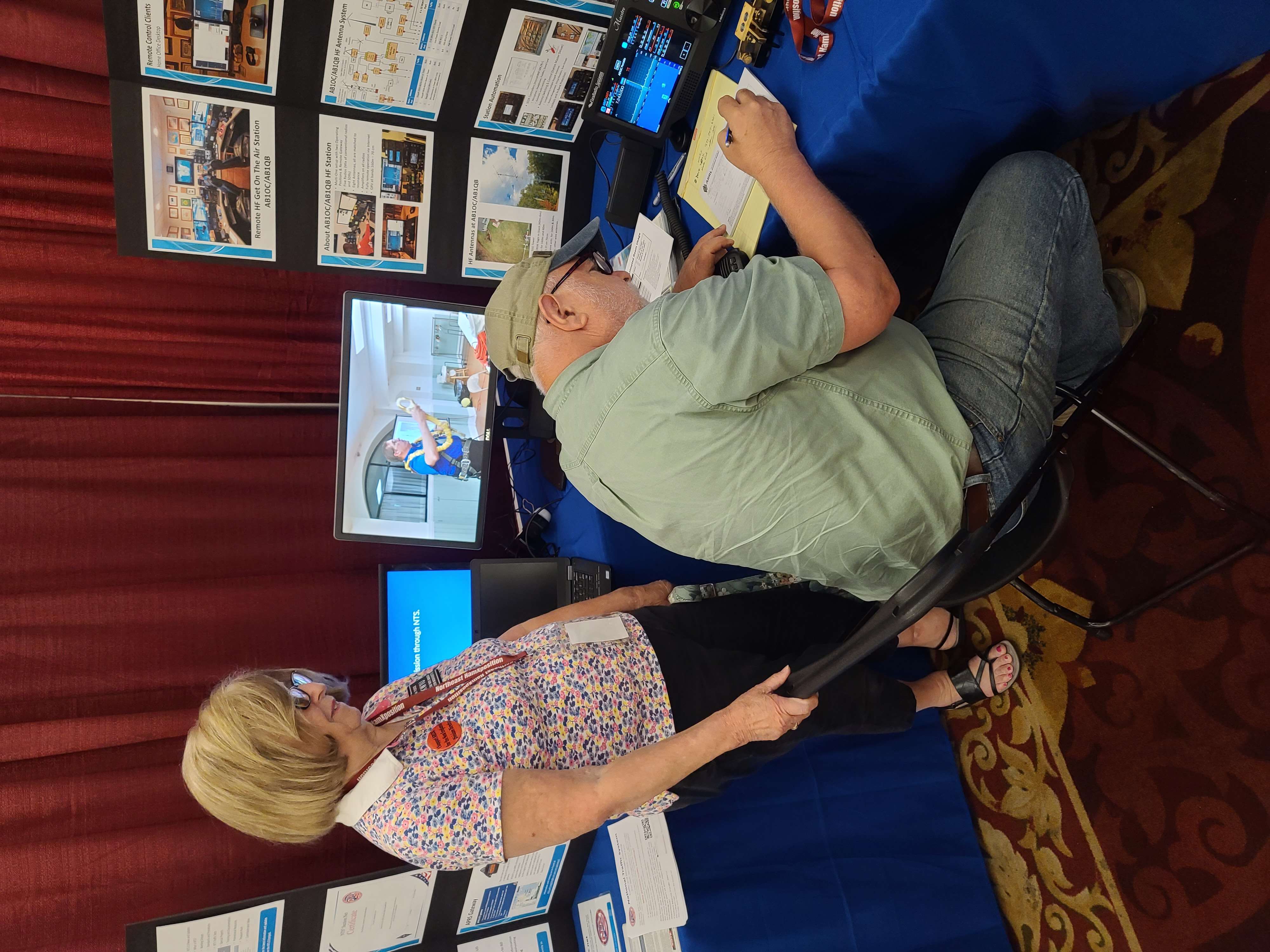
One of the highlights on Saturday was the operation of a traffic net operating remotely into an amateur radio station in New Hampshire.
With John Gotthardt, K1UAF, as Net Control, a regular session of the First Region Net was conducted for the benefit of visitors to observe how a traffic net operates.
|
 |
|
|
John Gotthardt, K1UAF, operating remotely as Net Control of First Region Net from the New England HamXposition with Marcia, KW1U, observing. | | | |
|
A presentation was also given on NTS®, including its background, the present featuring the various accomplishments of the NTS 2 working groups, and some planned future projects.
It was encouraging to see non-traffic handlers present who were engaged and who asked some good questions.
One person who worked for an emcomm agency stated how pleased he was to see the presentation of the encapsulated ICS-213 radiogram. Another question raised asked, in an emergency, how can a member of the public find an amateur radio operator to send a message when internet and cell service is down? Good topic for NTS 2 groups to be considering! We welcome your ideas.
There was also a meet-and-greet for current traffic handlers to get together and talk about what is going on traffic-wise in New England. It is always fun to have an “eyeball” with the folks with whom we pass messages over the air.
It is hoped that sharing experiences such as this can be encouraging and promote an exchange of ideas.
What’s going on in your area?
|
|
From the Field: Daily SSB Nets Provide Backbone for Florida
Dave Sheppard, W2PAX, SFL STM and Helen Straughn, WC4FSU, NFL STM |
|
Florida is fortunate to have a deep and dedicated traffic handling base.
The two daily SSB nets, the Florida Phone Traffic Net (FPTN) and the Tropical FAST Net TFN), provide a conduit into and out of the state to reach that base.
The Florida Phone Traffic Net operates daily at 0700 ET on 3940 kHz. FPTN tends to be more of an “inbound” net, on which the traffic load tends to be coming into the state.
This net liaises with the Digital Traffic Network (DTN) and the Fourth Region Net (4RN) for traffic coming from outside the state.
Local net liaisons include:
-
Southeast Florida Traffic Net (Miami/Fort Lauderdale/West Palm Beach)
-
Southwest Florida Traffic Net (Fort Myers/Naples/Port Charlotte)
-
EagleNet (Tampa/Lakeland/Sarasota)
-
Volusia County Traffic Net (Daytona area)
-
Seminole VHF Traffic Net (Orlando/Sanford area)
FPTN operates on a roster check-in system. Frequent check-ins who are part of the roster are called after net liaisons and stations with traffic. Other check-ins (“visitors”) are called for last. For more information about FPTN, please visit fptn3940.net.
In the evenings, the Tropical FAST Net (TFN) calls daily at 1800 ET. (The full name is Tropical Florida All Sideband Traffic Net.) In the winter, usually October to April, TFN is called on 3940 kHz. In the summer months, due to shorter band conditions, TFN is called on 7238 kHz. TFN is more of an “outbound” net, on which the traffic load tends more to be going out of state.
TFN liaises with the DTN and QFN (evening CW net) for out-of-state traffic, as well as the same local nets as FPTN.
TFN is conducted as an open check-in net after the net liaisons and traffic stations are handled.
For more information about TFN, please visit tropicalfast.net.
|
|
Traffic Tip from the Wisconsin STM: |
|
From the Wisconsin section FAQ # 276: When sending messages of any type in any mode, it’s important to know your receiver. If you send faster than you can write, it’s probably too fast for the receiver. If you are hearing interference on frequency, your receiver probably does, too. If you wouldn’t understand something without explanation in an operator’s note, your receiver will be puzzled as well.
Plain text wording, short sentences, and easy-to-understand terminology can help as messages are composed. Clear, methodical, sending will eliminate errors. In other, less famous, words – send unto others as you would have them send unto you. – Dennis Rybicke, K9LGU/STM
|
|
New Section Traffic Manager Group |
|
Because appointed section traffic managers throughout the country share much in common, including recruiting and training efforts, coordination of traffic and traffic nets throughout their sections and more, a new forum has been created at groups.io to encourage communication among them.
Topics include message traffic happenings, suggestions, questions, special events, special recognition, and anything else you would like to share with others in this group including input for The NTS Letter. An invitation was sent to 56 STMs. If you are an STM but haven’t signed on yet, please do so.
We look forward to your input.
|
|
Spotlight – Tom Doligalski, W4KX |
|
|
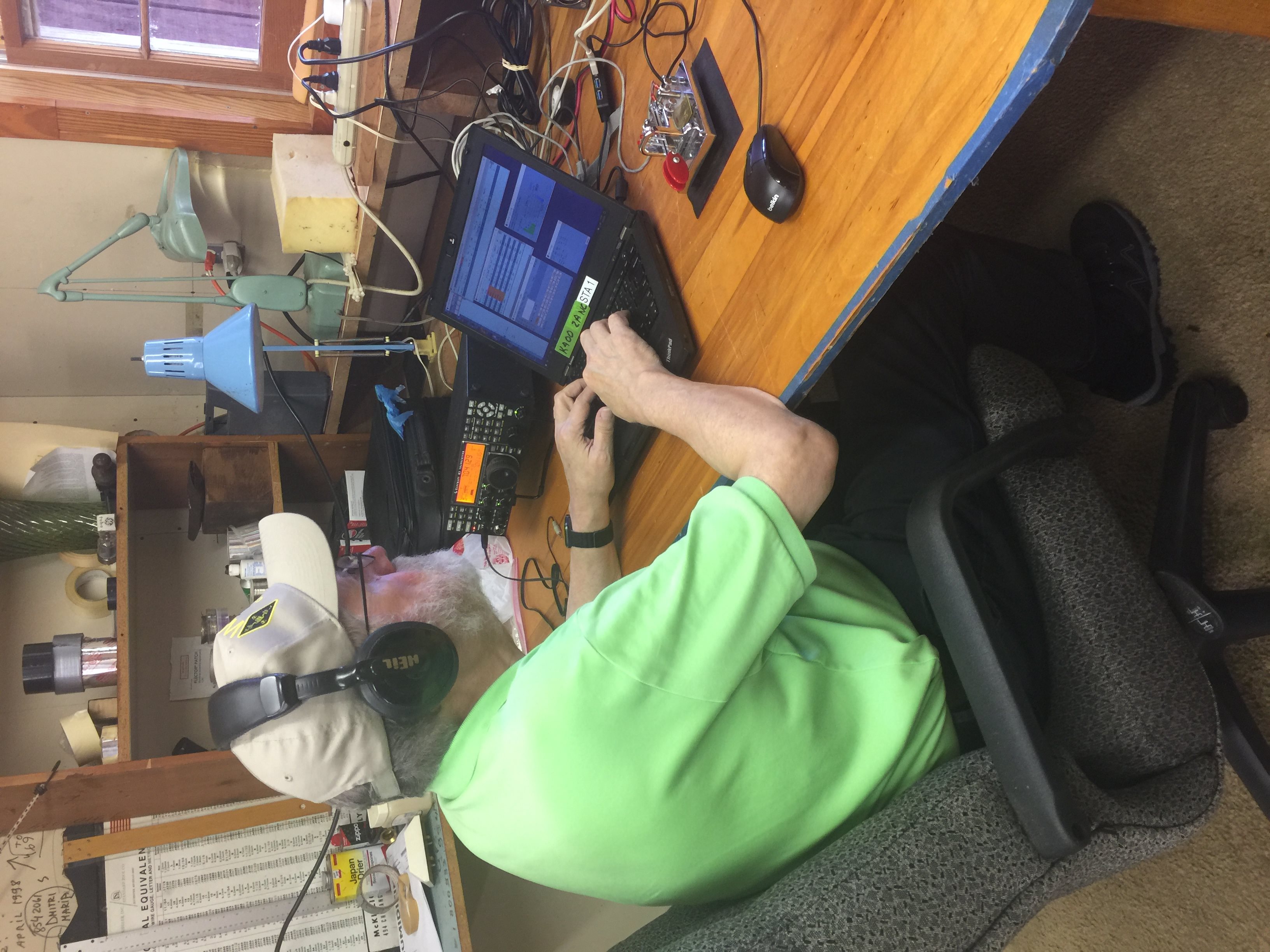
Tom Doligalski, W4KX, operating Field Day | | |
Tom says when he was a young boy, his father got him interested in electronics and when Tom was in junior high school, his dad encouraged him to join a local Boy Scout Explorer post which revolved around amateur radio.
He was first licensed in 1970 while living in Racine, Wisconsin.
It was this interest in amateur radio that influenced him to go to Purdue University to study engineering and where he received his Bachelor of Science degree in 1976. He went on to receive a Masters degree at Purdue followed by a Ph.D. in mechanical engineering from Lehigh University.
Tom ultimately retired as Director of the U.S. Army’s Basic Research in Engineering program.
Early on in Tom’s ham radio career, he attended the local ARRL Field Day and was immediately accepted by the CW operators (despite his only being a novice). His interest in traffic handling and traffic nets was piqued, leading him ultimately to serve as the ARRL Route Manager (RM) for the Wisconsin Intrastate Net (WIN), a position he held until going to college in 1972. He has been participating in amateur radio on and off since 1970, having taken time off to pursue college studies.
Upon moving to North Carolina in 1987, several local hams, including Will Harper, K4IWW, enticed Tom back into CW traffic handling.
For a long time, he served as NCS on the Carolinas CW Nets, which serve both North and South Carolina.
After retirement, he became active on the Hit and Bounce Net (HBN), which operates daily on 7112 kHz at 0830 ET, and for which he currently serves as Net Manager.
HBN is a traffic net frequented by seasoned traffic handlers from all points east of the Mississippi and even beyond.
He has promised to write an article about that net, which will appear in a future issue of The NTS Letter. Tom has also been a valuable contributor to the NTS 2 effort, serving on one of the working groups helping to improve and enhance the National Traffic System.
|
|
The National Traffic System® (NTS®) is a network of amateur radio operators who move information during disasters and other emergencies.
General messages offering well wishes also move through the NTS® to help test the system and to help amateur radio operators build traffic handling skills.
While the NTS® is primarily set up to serve the United States and Canada, it is possible to move traffic internationally through the NTS® through various local, regional, area, and international network connections.
NTS 2.0
NTS Manual
NTS Methods and Practices Guidelines
Handling Instructions
Numbered Texts
Form Encoding Rules for Form
|
|
Sign Up to Receive The NTS Letter |
|
The NTS® Letter is published monthly and is free of charge to ARRL members. Subscribe: www.arrl.org/opt-in-out
If anyone has not received copies of The NTS Letter by email, be sure to check www.arrl.org/opt-in-out
to confirm that you are opted in. If you don't see The NTS Letter listed among the publications you are opted into, click on "Edit," and you will have the opportunity to check the box to receive The NTS Letter. If you have missed any issues, you can find them all at www.nts2.arrl.org/nts-letter-issues
as well as on the ARRL website.
Editor: Marcia Forde, KW1U, Section Traffic Manager -- Eastern Massachusetts, Western Massachusetts, and Rhode Island
ARRL Director of Emergency Management: Josh Johnston, KE5MHV
|
|
NTS® is a program of ARRL The National Association for Amateur Radio®. No other organization works harder than ARRL to promote and protect amateur radio! ARRL members enjoy many benefits and services including digital magazines, e-newsletters, online learning (learn.arrl.org), and technical support.
Membership also supports programs for radio clubs, on-air contests, Logbook of The World®, ARRL Field Day, and the all-volunteer ARRL Field Organization.
|
|
The
NTS Letter is published every month (12 times each year). ARRL members may subscribe at no cost or unsubscribe by editing their Member Data Page at
www.arrl.org/opt-in-out.
Copyright © 2024 American Radio Relay League, Incorporated. Use and distribution of this publication, or any portion thereof, is permitted for non-commercial or educational purposes, with attribution. All other purposes require written permission.
|
|
| |
| | | |